
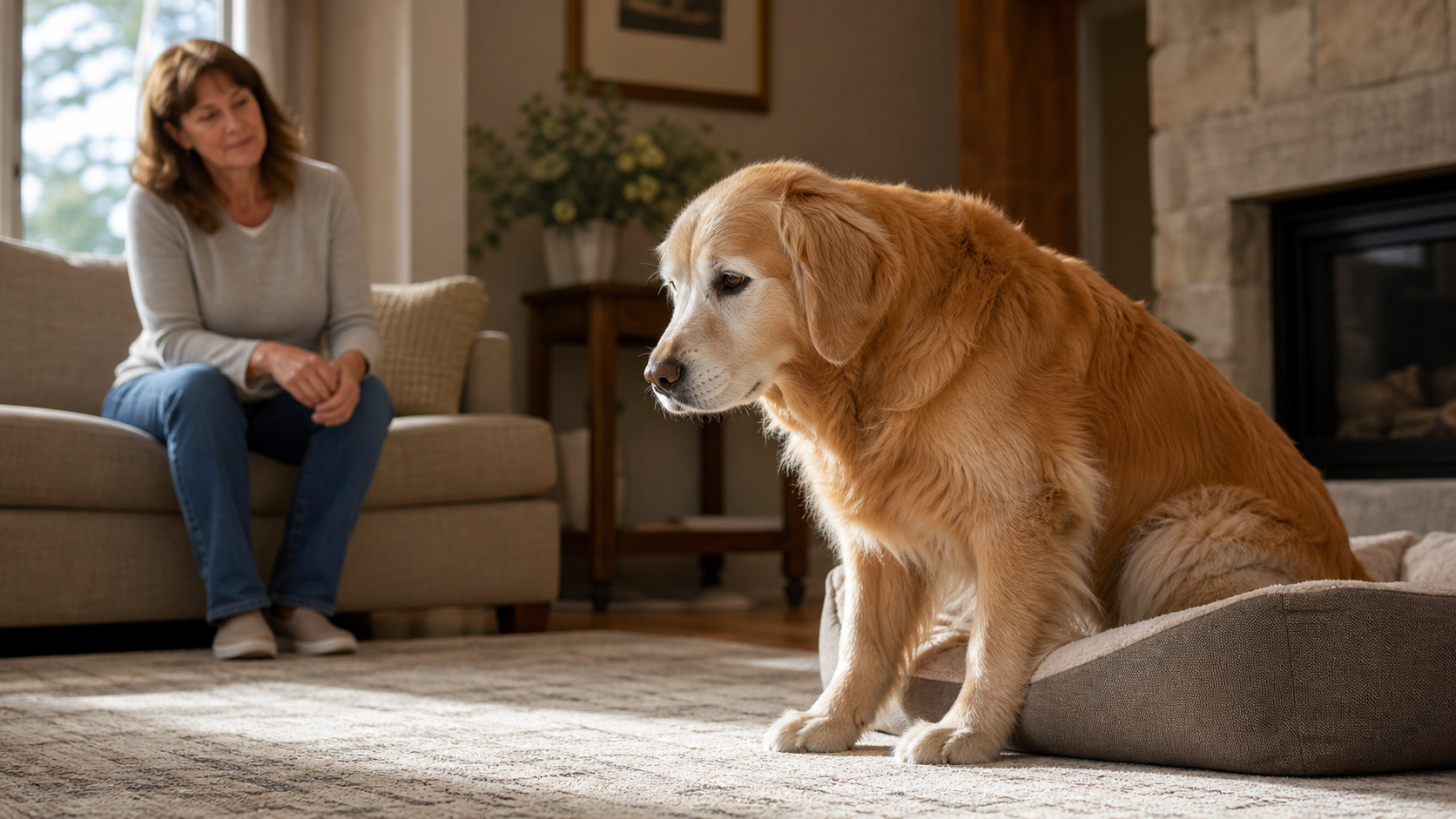
He still eats dinner. He still wags when you come home. He can still walk when he really wants to.
So when your senior dog stops racing to the door, takes longer to stand, or turns down a favorite game, the easiest explanation is: "He is old. He is just getting lazy."
But "slowing down" is a description, not a diagnosis.
Some changes come with age. Others may reflect pain, weakness, sensory changes, illness, fear, or several problems at once. A single sign cannot tell you which explanation is correct. What matters is a new pattern in how your dog moves, rests, eats, sleeps, or connects with the family.
Dogs do not need to cry for pain to be real. According to [Cornell University's guide to recognizing pain in dogs](https://www.vet.cornell.edu/departments-centers-and-institutes/riney-canine-health-center/canine-health-topics/recognizing-pain-dogs), pain-related behavior can develop gradually, and the person who knows the dog's normal routine is often best positioned to notice the first small differences.
Here are nine quiet clues that deserve a closer look.
## 1. Standing Up Has Become a Small Production
Watch the first five seconds after a nap.
Does your dog rock forward before rising, make several attempts, push mostly with the front legs, or pause after reaching a standing position? Does the stiffness ease after a few steps?
Difficulty transitioning from lying down to standing can accompany pain or reduced mobility. [AAHA lists stiffness, limping, reluctance to move, and difficulty changing position](https://www.aaha.org/resources/whats-wrong-common-pet-pain-signs/) among signs that warrant attention. Look for repetition rather than judging one awkward rise.
## 2. Your Dog Has Started Editing the Route
A dog who once followed you upstairs may now wait below. A dog who loved the couch may circle it without jumping. A dog who hurried into the car may plant all four feet and stare.
That can look like stubbornness. It may also be a practical decision after a movement felt uncomfortable or unstable.
Notice avoidance of:
- Stairs, curbs, and door thresholds
- Jumping into or out of a car
- Slick floors
- Tight turns
- Squatting to eliminate
- Lowering the head to a bowl
The [AVMA senior pet guide](https://ebusiness.avma.org/files/ProductDownloads/mcm-client-brochures-senior-pets-2023.pdf) notes that avoiding running, jumping, stairs, or car entry can be a warning sign.
## 3. The Walk Is Still Happening, but It Is Not the Same Walk
Distance alone can hide a lot. Your dog may complete the usual block while moving differently.
Look for a shorter stride, lagging, repeated stopping, toe scuffing, a lowered head, or reluctance to turn one direction. Compare the beginning and end of the walk.
Never push a senior dog to "prove" what they can do. A short video of a natural walk, taken from the side and from behind, can be more useful to your veterinarian than a forced test.
## 4. Rest No Longer Looks Restful
Pain does not always make a dog sleep peacefully. It can make settling difficult.
A dog may circle repeatedly, lower the body and rise again, change locations all night, avoid one side, or sleep unusually. The clue is not simply "more sleep." It is a change from your dog's baseline or an inability to settle.
## 5. Touch Has New Rules
Your formerly cuddly dog may move away when brushed, tense during nail trims, turn the head toward your hand, lick the lips, flatten the ears, growl, or snap when lifted.
Do not punish the warning. A sudden change in tolerance can be communication, not bad character. Pain may make a familiar touch feel threatening because your dog expects discomfort.
Note the location and situation, but do not repeatedly press, bend, or manipulate a sore area. Let the veterinarian perform the hands-on assessment safely.
## 6. Personality Changes Arrive Before a Limp
Some painful dogs withdraw. Others become clingier. A social dog may leave the room when children approach. A relaxed dog may guard a bed. A patient dog may seem irritable around another pet.
AAHA includes withdrawal, fearfulness, irritability, aggression, and other out-of-character behavior among possible pain signs. Behavior changes can also have medical, sensory, cognitive, or environmental causes, so they should not be self-diagnosed from one symptom.
The useful question is: "What changed, when did it start, and what was happening immediately before it?"
## 7. Favorite Activities Have Quietly Disappeared
Pain is not always visible in what a dog does. Sometimes it appears in what the dog stops doing.
Maybe the toy basket is untouched. The window greeting is gone. The dog still comes outside but no longer sniffs the whole yard. The tail still wags, yet the invitation to play never arrives.
List three behaviors that feel most like your dog. Track whether they still happen, how often, and for how long.
## 8. Panting, Facial Tension, or Vocalizing Happens Out of Context
Panting after exercise or in warm weather can be normal. Panting while resting in a comfortable room is different. So are new groans, whimpers, repeated sighing, flattened ears, a tense mouth, or a glazed expression.
These signs are not specific to pain. Panting or altered breathing has several possible causes, including heart or lung problems, so discuss a new unexplained pattern with a veterinarian.
Difficulty breathing, blue or pale gums, or collapse requires urgent care. [AAHA's pet emergency guide](https://www.aaha.org/resources/help-is-this-a-pet-emergency/) identifies breathing trouble and sudden extreme weakness or paralysis as emergency signs.
## 9. Daily Habits Change Around the Same Time
Pain can affect more than movement. Cornell includes changes in appetite, sleep, house training, activity, posture, grooming, and social behavior among patterns caregivers may notice.
Watch for clusters:
- Moving less and gaining weight
- Eating less and losing weight
- Sleeping more but appearing restless at night
- House accidents alongside difficulty squatting or reaching the door
- Repeated licking or chewing at one body area
- Hesitation at the bowl plus dropping food or chewing differently
A cluster does not prove pain, and pain may not be the only issue. It tells you the change is broader than "one slow day."
## Run a Seven-Day Observation, Not a Home Diagnosis
If your dog is stable and the change is not an emergency, collect useful evidence for a week while arranging veterinary guidance.
Each day, record:
1. How long it takes your dog to rise after rest
2. Which activities are refused, shortened, or completed differently
3. Appetite, water intake, sleep, and bathroom changes
4. When the change is most noticeable
5. Whether the pattern is improving, stable, or worsening
Take brief videos of normal moments: rising, walking, using a curb, and settling into bed. Do not stage risky movements. Dogs may behave differently at a clinic because of excitement, fear, or adrenaline, so home videos can add valuable context. Cornell specifically recommends photos, videos, and written notes when pain is suspected.
## When to Contact Your Veterinarian
Call for an appointment when a new change persists, recurs, progresses, limits a normal activity, or affects appetite, sleep, elimination, or social behavior. A mild limp that lasts more than a day or two, or any pain that is sudden, severe, or worsening, should not be ignored; [Cornell's lameness guidance](https://www.vet.cornell.edu/departments-centers-and-institutes/riney-canine-health-center/canine-health-information/what-to-expect-when-taking-your-limping-dog-to-the-veterinarian) recommends veterinary attention in those situations.
Seek emergency care for sudden inability to stand or walk, collapse, difficulty breathing, pale or blue gums, major trauma, uncontrolled bleeding, a swollen painful abdomen, repeated unproductive retching, seizures, or severe unrelenting distress.
Do not give human pain medicine or change an existing medication plan unless your veterinarian specifically directs you to do so. The cause matters, and safe treatment depends on the individual dog's health, current medications, examination, and sometimes diagnostic tests.
## The Sentence Worth Retiring
"He is just old" can end an observation too early.
A better sentence is: "This is new for him."
That wording does not create panic or assume a diagnosis. It simply respects the difference between aging and suffering. Your senior dog may still eat, wag, and love the same people while quietly adjusting life around discomfort. Noticing those adjustments is not overreacting. It is careful caregiving.
---
## Sources
1. [American Animal Hospital Association: Common Pet Pain Signs](https://www.aaha.org/resources/whats-wrong-common-pet-pain-signs/)
2. [Cornell University College of Veterinary Medicine: Recognizing Pain in Dogs](https://www.vet.cornell.edu/departments-centers-and-institutes/riney-canine-health-center/canine-health-topics/recognizing-pain-dogs)
3. [American Veterinary Medical Association: Senior Pets](https://ebusiness.avma.org/files/ProductDownloads/mcm-client-brochures-senior-pets-2023.pdf)
4. [Cornell University College of Veterinary Medicine: What to Expect When Taking Your Limping Dog to the Veterinarian](https://www.vet.cornell.edu/departments-centers-and-institutes/riney-canine-health-center/canine-health-information/what-to-expect-when-taking-your-limping-dog-to-the-veterinarian)
5. [American Animal Hospital Association: Help! Is This a Pet Emergency?](https://www.aaha.org/resources/help-is-this-a-pet-emergency/)
## Medical Disclaimer
This article is for general educational purposes only. It cannot diagnose pain or any medical condition and is not a substitute for an examination by a licensed veterinarian. Contact your veterinarian for advice tailored to your dog. If your dog has severe, sudden, or rapidly worsening signs, seek urgent veterinary care.