
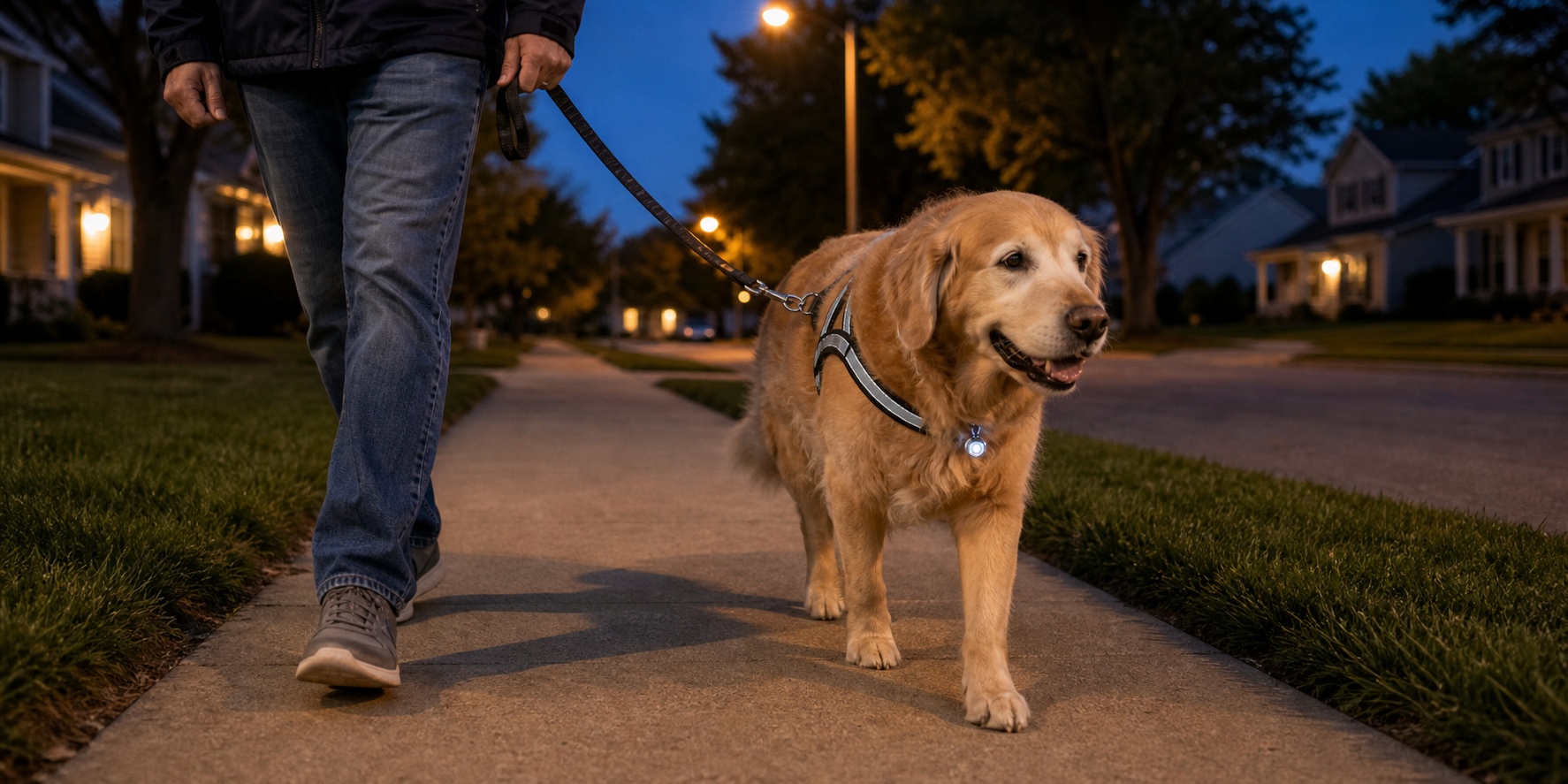
Night walks can be quieter, cooler, and less crowded than daytime outings, but they also introduce challenges that matter more as a dog ages. Reduced vision, hearing changes, slower reactions, joint stiffness, and lower tolerance for heat or cold can make a once-simple neighborhood walk feel very different.
Good senior dog night walk safety is not about covering your dog in gadgets or completing a certain distance. It is about choosing an outing that matches your dog’s current abilities while helping both of you remain visible, connected, and aware of the environment.
Use these eight practical tips to make after-dark walks more comfortable and predictable.
## 1. Choose a Short, Familiar Route
A familiar block is often a better choice than a new trail after dark. Your senior dog may already know the curbs, driveways, sounds, and usual stopping points, reducing the number of surprises they must process in low light.
Plan a route with:
- Even sidewalks or stable walking surfaces
- Reliable street lighting
- Few stairs and steep slopes
- Safe, controlled road crossings
- An easy opportunity to turn home early
Older dogs often benefit from a consistent routine. Familiar does not need to mean boring—allowing your dog to stop and sniff can provide mental enrichment without adding unnecessary distance.
## 2. Let Your Dog Set the Pace
The [American Animal Hospital Association](https://www.aaha.org/resources/aging-with-grace-how-to-support-your-senior-pet/) recommends adjusting senior-pet exercise to the individual dog’s health and mobility. Gentle walks that are short but consistent may be more appropriate than occasional long outings.
Begin slowly and give your dog time to loosen up. Avoid pulling them forward or trying to maintain your previous walking speed. A relaxed sniff walk can still be meaningful exercise, even if you do not travel far.
The ideal duration cannot be determined by age alone. Breed, weight, fitness, arthritis, heart or lung conditions, medications, and recent illness can all affect stamina. Ask your veterinarian how much activity is appropriate for your dog rather than relying on a universal time or distance.
## 3. Check the Weather and the Ground
A cooler evening does not automatically mean the pavement is safe. Asphalt and concrete can retain heat after sunset, and high humidity can make it harder for dogs to cool themselves. [AAHA advises checking pavement conditions](https://www.aaha.org/resources/how-to-protect-dog-paws-from-hot-pavement/), with extra caution for senior, overweight, short-nosed, and medically fragile dogs.
In cold weather, older dogs may become uncomfortable more quickly, especially if they have arthritis, a thin coat, or limited mobility. Shorten the walk during temperature extremes and consider a properly fitted coat when appropriate.
Before leaving, check for:
- Hot pavement
- Ice, snow, or wet leaves
- Road salt and deicing chemicals
- Heavy rain or poor visibility
- Extreme heat, humidity, wind, or cold
After winter walks, wipe the paws and remove grit or salt from between the pads. During warm weather, turn back immediately if your dog shows excessive panting, weakness, stumbling, or unusual reluctance to continue.
## 4. Use Secure, Well-Fitted Walking Equipment
Inspect the harness or collar, leash clip, stitching, and identification tag before every night walk. Equipment should fit securely without rubbing, restricting movement, or allowing your dog to back out when startled.
A standard fixed-length leash generally provides closer control near roads, bicycles, wildlife, and other dogs. Reflective stitching can also make the line easier for other people to see. Long or thin retractable cords can be difficult to notice after dark and may allow a dog to reach a hazard before the handler can respond.
If your senior dog has neck, back, balance, or mobility problems, ask your veterinarian or canine rehabilitation professional whether a harness or another walking aid is more appropriate. A visibility light must never be used as the leash attachment point unless the product is specifically designed and rated for that purpose.
Keep your dog’s identification information and microchip registration current. Lights improve visibility; they do not identify or locate a dog that gets loose.
## 5. Make Both Dog and Handler Easier to See
Reflective gear returns light from headlights and flashlights, while an LED light produces its own illumination. Using both can improve visibility from different angles.
Consider combining:
- A reflective harness, collar, or leash
- A light-colored or reflective jacket for the handler
- A flashlight or headlamp for viewing the ground
- A [rechargeable LED dog collar safety light](https://tendrapaw.com/products/rechargeable-led-dog-collar-safety-light) attached securely where it remains visible
Charge the safety light before leaving and confirm that it turns on properly. Position it so it does not interfere with the leash, press against the throat, or shine continuously into your dog’s eyes.
An LED safety light is a visibility aid only. It is not a GPS tracker, does not show your dog’s location on a phone, and does not replace a leash, identification tag, microchip, or close supervision. Reflective and illuminated equipment can make you easier to notice, but no product can guarantee that a driver sees you or prevent an accident.
## 6. Scan the Route Before Your Dog Reaches It
At night, hazards can appear with little warning. Use your flashlight to check the pavement ahead for broken glass, holes, branches, standing water, uneven curbs, or discarded food.
Keep enough attention available to notice:
- Vehicles entering or leaving driveways
- Cyclists, scooters, and runners
- Loose dogs
- Wildlife
- Construction zones
- Sudden noises or motion-activated decorations
Avoid headphones that prevent you from hearing approaching traffic. Senior dogs may not hear vehicles, people, or animals approaching as clearly as they once did, so the handler may need to provide that awareness.
Give other dogs and pedestrians extra space. A dog with reduced hearing or vision may startle when someone appears suddenly nearby, even if they were previously comfortable with strangers.
## 7. Watch Your Dog, Not the Step Counter
Your dog’s movement and behavior should determine when the walk ends. Turn home if you notice:
- Falling behind or stopping repeatedly
- Limping, shortened steps, or an uneven gait
- Excessive panting unrelated to normal effort
- Shivering or lifting the paws
- Stumbling or dragging the toes
- Confusion at familiar turns
- Reluctance to cross a street or continue forward
- Sudden anxiety or repeated attempts to go home
Do not encourage a senior dog to “push through” discomfort to complete a planned distance. If they regularly tire halfway around the route, shorten the route before the next walk.
Carry water when the temperature, distance, or your dog’s medical needs make it appropriate. Some dogs may also benefit from [senior dog mobility aids](https://tendrapaw.com/collections/senior-dog-mobility), but equipment should support a suitable activity plan rather than enable overexertion.
## 8. Create a Calm, Well-Lit Return Home
The walk is not finished the moment you reach the door. A dark entry, slippery threshold, or cluttered hallway can be difficult to navigate when a senior dog is tired.
A [motion sensor pet night light](https://tendrapaw.com/products/motion-sensor-pet-night-light) near the entrance or hallway can illuminate the route as you return. Place it where it lights the floor without shining directly at your dog. Keep the landing area clear, and provide a stable surface where your dog can pause while you remove the leash.
After the walk:
1. Dry wet fur and paws.
2. Check the pads for cuts, irritation, ice, or debris.
3. Offer fresh water.
4. Observe how easily your dog settles or stands up afterward.
5. Recharge the LED safety light so it is ready for the next outing.
A predictable post-walk routine can help an older dog transition calmly from outdoor activity to rest.
## When Nighttime Changes Need Veterinary Attention
A new reluctance to walk after dark, bumping into objects, hesitation at curbs, or difficulty finding a familiar doorway may indicate a vision problem. Night pacing, disorientation, altered sleep patterns, or getting lost on a familiar route can also occur with canine cognitive dysfunction.
Likewise, reduced stamina, repeated limping, weakness, coughing, or heavy breathing may be related to pain or another medical condition. Do not assume these changes are an unavoidable part of aging.
Arrange a veterinary examination when a behavior or mobility change is new, worsening, or interfering with normal activities. Home and walking accessories can support a well-designed routine, but they cannot diagnose or treat vision loss, pain, cognitive change, or heart and lung disease.
A successful night walk does not need to be long. A familiar route, a comfortable pace, secure equipment, better visibility, and attention to your dog’s signals can make a short outing both enriching and reassuring.
*This article provides general educational information and is not a substitute for veterinary diagnosis or treatment.*
---
# Internal Links Used
- `rechargeable LED dog collar safety light` → `https://tendrapaw.com/products/rechargeable-led-dog-collar-safety-light`
- `motion sensor pet night light` → `https://tendrapaw.com/products/motion-sensor-pet-night-light`
- `senior dog mobility aids` → `https://tendrapaw.com/collections/senior-dog-mobility`
- Optional additional link: `rear lift support harness for dogs` → `https://tendrapaw.com/products/rear-lift-support-harness-for-dogs`
# Reference Sources
- [AAHA — Aging With Grace: How to Support Your Senior Pet](https://www.aaha.org/resources/aging-with-grace-how-to-support-your-senior-pet/)
- [AAHA — Lifestyle and Safety Assessment for Dogs](https://www.aaha.org/resources/life-stage-canine-2019/lifestyle-and-safety-assessment/)
- [AAHA — How to Prevent Heatstroke in Dogs and Cats](https://www.aaha.org/resources/how-to-prevent-heatstroke-in-dogs-and-cats/)
- [AAHA — How to Protect Your Dog’s Paws From Hot Pavement](https://www.aaha.org/resources/how-to-protect-dog-paws-from-hot-pavement/)
- [AAHA — Cold Weather Pet Safety Tips](https://www.aaha.org/resources/cold-safety-for-pets/)
- [Cornell University College of Veterinary Medicine — Senior Dog Dementia](https://www.vet.cornell.edu/departments-centers-and-institutes/riney-canine-health-center/canine-health-information/senior-dog-dementia)
- [RSPCA — Walking Your Dog Safely and Responsibly](https://www.rspca.org.uk/adviceandwelfare/pets/dogs/walking)