
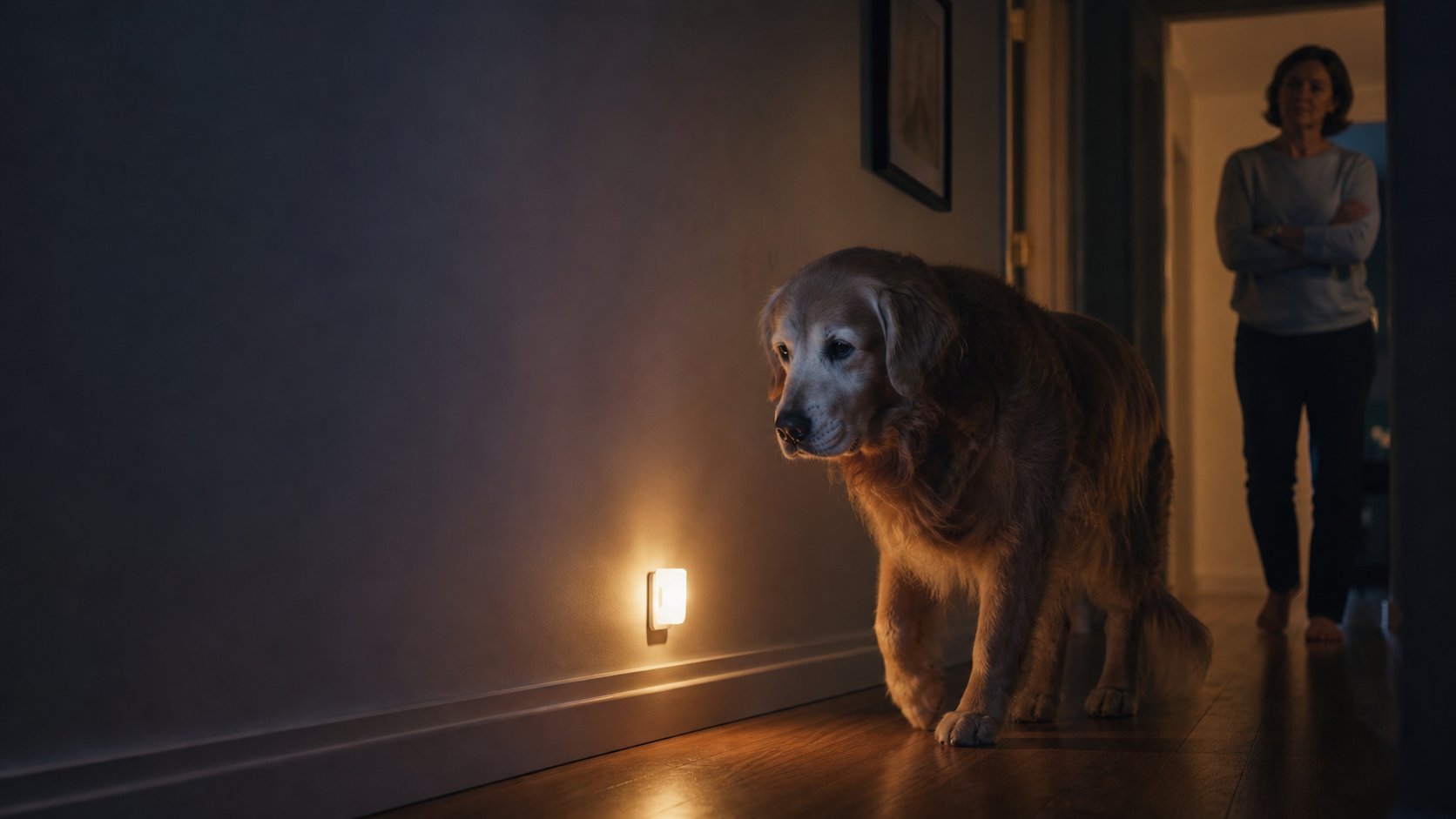
At 2:13 a.m., you hear nails moving across the floor.
Your senior dog walks from the bedroom to the hallway, pauses in front of a blank wall, and stands there. A few minutes later, the pacing starts again. By morning, your dog is finally asleep - and may remain asleep for much of the day.
It is tempting to say, "He is old. Old dogs do strange things."
Please pause there.
Nighttime pacing, staring at walls, getting stuck in corners, vocalizing after dark, and reversing the usual day-night routine are not proof of dementia. But they are also not behaviors to dismiss as an unavoidable personality change. They can be clues that your dog is uncomfortable, disoriented, unable to sense the environment normally, or experiencing another medical problem.
The right response is not panic. It is attention.
## Three Changes Owners Often Notice First
### 1. Pacing when the house becomes quiet
Your dog may walk the same route repeatedly, seem unable to settle, pant without obvious heat or exercise, or wake the household several times. Some dogs move with purpose; others appear to wander.
Pacing alone does not tell you why it is happening. Pain may make lying down difficult. Anxiety may become more noticeable in darkness. A need to urinate, a medication effect, sensory loss, or a neurologic problem may also disturb sleep.
### 2. Staring at walls or getting stuck
A dog may face a wall, pause behind furniture, enter a corner and appear unable to back out, or wait at the wrong side of a familiar door. Cornell lists getting lost in familiar places, becoming stuck in corners, and staring into space among the signs seen with canine cognitive dysfunction syndrome.
There is an important distinction: a brief pause while listening or smelling is not automatically abnormal. Look for a new pattern, repetition, reduced responsiveness, or difficulty navigating a familiar space.
### 3. Sleeping all day and staying awake at night
Senior dogs often rest more than younger dogs, but a clear reversal of the sleep-wake cycle deserves notice. The [AAHA senior care guidance](https://www.aaha.org/resources/2023-aaha-senior-care-guidelines-for-dogs-and-cats/managing-cognitive-dysfunction-and-behavioral-anxiety/) identifies daytime sleeping and nighttime restlessness among common signs reported in dogs with cognitive dysfunction. An [observational study of older dogs](https://pubmed.ncbi.nlm.nih.gov/23701137/) also found that daytime sleep combined with nighttime restlessness was one of the dominant clinical patterns in affected dogs.
This still does not mean every restless senior dog has cognitive dysfunction. It means the change belongs in the veterinary conversation.
## The Pattern Veterinarians Call DISHAA
Veterinary teams often organize age-related cognitive and behavior changes under the acronym DISHAA:
- **D - Disorientation:** getting lost, staring, becoming stuck, or appearing confused
- **I - Interaction changes:** becoming unusually withdrawn, clingy, irritable, or less responsive
- **S - Sleep-wake changes:** sleeping more by day, wandering or vocalizing at night
- **H - House-soiling:** new indoor urination or defecation after years of reliable training
- **A - Activity changes:** pacing, repetitive behavior, restlessness, or reduced interest
- **A - Anxiety:** new fears, distress when separated, or difficulty settling
The [American Veterinary Medical Association's senior pet guide](https://ebusiness.avma.org/files/ProductDownloads/mcm-client-brochures-senior-pets-2023.pdf) similarly tells owners to watch for confusion, altered social interaction, sleep-wake changes, and loss of previously learned house-training behavior.
One sign on one unusual night may have a simple explanation. Several changes developing together, becoming more frequent, or interfering with normal life create a much stronger reason to schedule an examination.
## Cognitive Dysfunction Is One Possibility, Not the Only One
Canine cognitive dysfunction is an age-associated neurodegenerative syndrome. Veterinary guidance describes its characteristic domains as disorientation, interaction changes, sleep-wake disturbance, house-soiling, activity changes, and anxiety.
However, cognitive dysfunction is generally approached as a diagnosis of exclusion. In plain English, a veterinarian must consider other causes that can look similar.
Those possibilities may include:
- **Pain or mobility problems:** arthritis, spinal discomfort, or another painful condition may make it hard to lie down, rise, or remain in one position.
- **Vision or hearing loss:** darkness and reduced sensory input can make a familiar room harder to navigate.
- **Systemic illness:** kidney, liver, endocrine, urinary, gastrointestinal, or other disease can change sleep, thirst, elimination, energy, and behavior.
- **Neurologic disease:** seizures, inflammation, vascular events, or a structural brain problem can cause altered behavior or awareness.
- **Medication effects:** a new drug, dose change, timing change, or interaction may affect alertness, anxiety, thirst, or sleep.
- **Environmental stress:** a move, construction noise, a new pet, schedule disruption, or loss of a companion can change behavior.
According to [Cornell's canine cognitive dysfunction overview](https://www.vet.cornell.edu/departments-centers-and-institutes/riney-canine-health-center/canine-health-topics/cognitive-dysfunction-syndrome), veterinarians may use a physical examination, bloodwork, urinalysis, and sometimes advanced imaging to investigate conditions with similar signs, including pain, arthritis, seizure disorders, systemic illness, sensory loss, and brain disease.
That is why an online checklist cannot diagnose your dog.
## Make a Seven-Day Record Before the Details Blur
A useful record is specific, repeatable, and easy to show your veterinarian. Start tonight if the behavior is recurring, but do not delay care to complete a full week when the change is sudden, severe, or worsening.
For each episode, record:
1. **Start and end time:** Note how long the dog paced, stared, vocalized, or remained unsettled.
2. **Exact behavior:** "Walked bedroom-hallway route 11 times" is more useful than "acted weird."
3. **Responsiveness:** Did your dog turn toward their name, a hand clap, a light, food, or gentle touch?
4. **Navigation:** Record wrong-door waiting, corner trapping, bumping into objects, circling, falling, head tilt, or unusual eye movement.
5. **Body signs:** Include panting, trembling, limping, stiffness, coughing, repeated swallowing, abdominal tension, or difficulty lying down.
6. **Daily basics:** Track appetite, water intake, urination, stool, accidents, walks, naps, and unusual fatigue.
7. **Context:** Note lighting, noise, visitors, weather, household changes, and whether the episode followed exercise or medication.
8. **Medication and supplements:** List the product, dose, and time given. Do not stop a prescribed medication without veterinary advice.
Take short videos when it is safe. Film the whole dog and some of the surrounding room, not only the face. A video can preserve gait, posture, route, responsiveness, and duration more accurately than memory after a sleepless night.
Also bring a current medication list and a simple floor plan marked with the repeated path or places where your dog becomes stuck.
## What Not to Do at 2 A.M.
Do not punish, shout, or force a confused dog to "snap out of it." Do not give human sleep medication, cannabis products, antihistamines, or leftover veterinary drugs unless a veterinarian specifically directs you to do so. Even seemingly familiar products can be unsafe, interact with prescriptions, or conceal worsening signs.
Avoid making five major household changes at once. If you change lighting, sleeping location, feeding time, exercise, and supplements together, neither you nor your veterinarian can tell what influenced the pattern.
Most importantly, do not isolate a distressed senior simply because the pacing wakes you. AAHA's discussion of canine sleep notes that nighttime pacing, vocalizing, and reversed day-night patterns warrant veterinary attention; moving a disoriented dog away from the family may hide the warning without addressing the cause.
## Red Flags: When Waiting Is the Wrong Choice
Call an emergency veterinary clinic immediately for guidance if the behavior begins suddenly or occurs with:
- Collapse, unresponsiveness, or inability to stand
- A seizure, active tremoring, or repeated episodes of lost awareness
- Severe loss of balance, new head tilt, rapid abnormal eye movements, or sudden blindness
- Trouble breathing, blue or very pale gums, or extreme weakness
- Suspected toxin or unintended medication ingestion
- Severe pain, major trauma, uncontrolled bleeding, or inability to urinate
[Cornell's emergency service](https://www.vet.cornell.edu/hospitals/services/emergency-and-critical-care-0) lists unresponsiveness, breathing difficulty, collapse, loss of balance, weakness, toxin ingestion, difficulty urinating, and seizure activity among emergent conditions.
If there is no immediate crisis, arrange a veterinary appointment soon rather than waiting for the next routine annual visit when pacing, disorientation, wall-staring, sleep reversal, house-soiling, anxiety, or loss of learned behavior is new, recurring, or progressing. Earlier recognition matters because both cognitive and non-cognitive causes may benefit from earlier evaluation and support.
## The Most Helpful Sentence You Can Say
Do not tell the veterinarian only, "My dog is getting old."
Say this instead:
"Over the last three weeks, she has started pacing between midnight and 2 a.m. four nights a week, sleeps much more during the day, and has twice become stuck behind the bathroom door. I have videos and a log."
That sentence turns a vague worry into usable clinical information.
Your senior dog cannot explain what the 2 a.m. hallway feels like. Careful observation is how you speak for them.
---
## Sources
1. [Cornell University College of Veterinary Medicine: Cognitive dysfunction syndrome](https://www.vet.cornell.edu/departments-centers-and-institutes/riney-canine-health-center/canine-health-topics/cognitive-dysfunction-syndrome)
2. [AAHA: Managing Cognitive Dysfunction and Behavioral Anxiety](https://www.aaha.org/resources/2023-aaha-senior-care-guidelines-for-dogs-and-cats/managing-cognitive-dysfunction-and-behavioral-anxiety/)
3. [AVMA: Senior Pets client guide](https://ebusiness.avma.org/files/ProductDownloads/mcm-client-brochures-senior-pets-2023.pdf)
4. [AAHA: How Sleep Shapes Canine Behavior](https://www.aaha.org/trends-magazine/publications/how-sleep-shapes-canine-behavior/)
5. [Journal of Veterinary Internal Medicine via PubMed: Clinical characteristics of canine cognitive dysfunction](https://pubmed.ncbi.nlm.nih.gov/23701137/)
6. [Cornell University College of Veterinary Medicine: Emergency and Critical Care](https://www.vet.cornell.edu/hospitals/services/emergency-and-critical-care-0)
## Medical Disclaimer
This article is for general educational purposes and is not a diagnosis or a substitute for veterinary care. Behavior and sleep changes can have many causes. Contact your veterinarian for advice tailored to your dog, and seek emergency veterinary care for sudden or severe signs.