
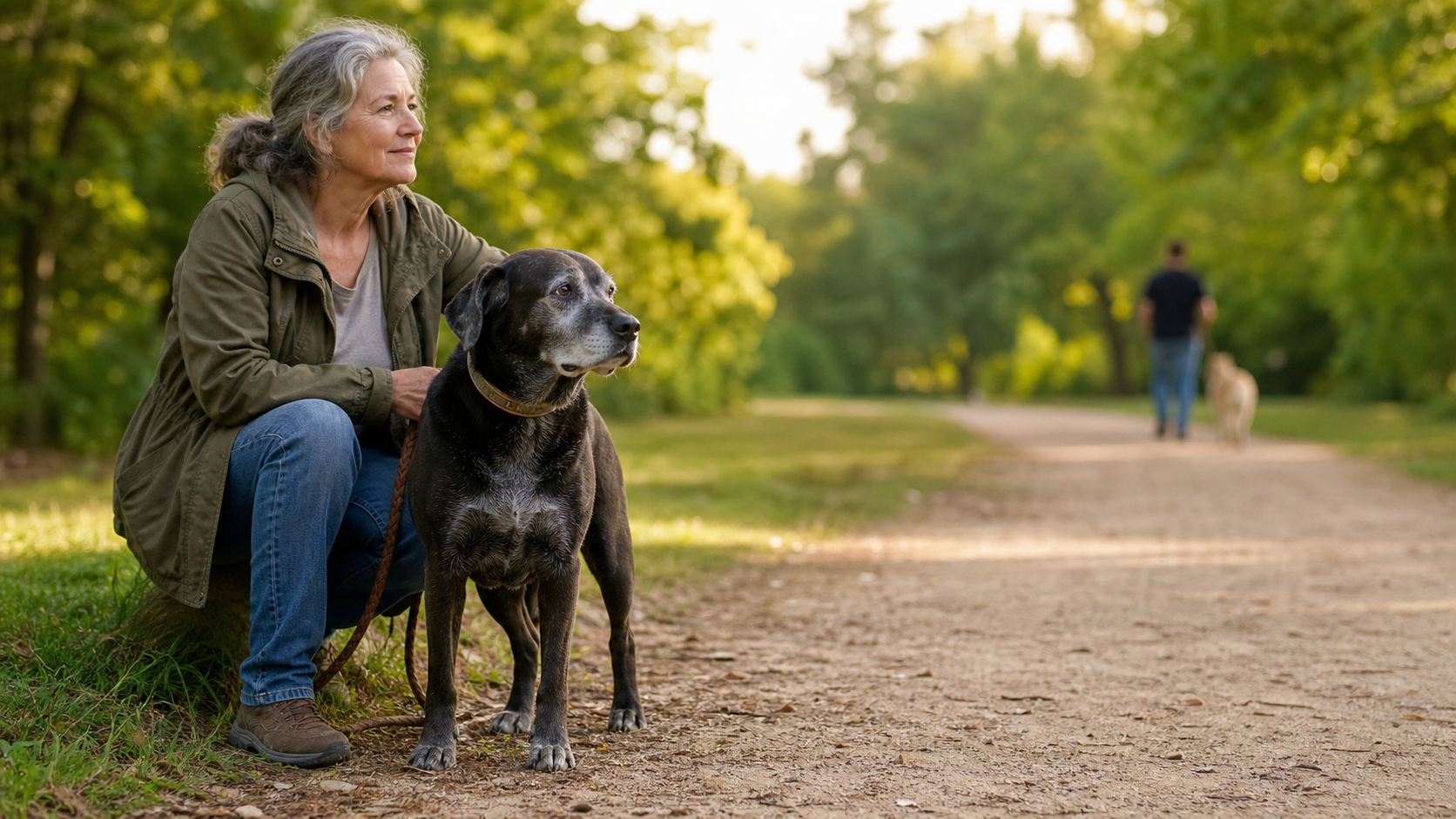
Your Senior Dog Didn't Become "Mean": The Behavior Change You Need to Take Seriously
The dog who welcomed every visitor now backs away.
The dog who tolerated a young dog at the park now stiffens, growls, or snaps.
The dog who loved ear scratches suddenly turns their head away when a hand comes close.
It is tempting to call this a bad attitude. In a senior dog, it is more useful to treat it as a change in communication.
Growling is not proof that a dog is "mean." It is a warning signal. Punishing the warning can remove the signal without removing the discomfort, fear, confusion, or trigger behind it.
The [AAHA behavior guidelines](https://www.aaha.org/resources/behavior-management-for-pets/) explain that senior behavior changes can be influenced by vision loss, hearing loss, reduced flexibility, and underlying medical issues. A new behavior change deserves attention, especially when it is out of character.
## Why a Social Dog May Start Wanting Space
Aging can change what feels safe or comfortable.
An older dog may have less patience for noisy greetings, fast movement, unpredictable children, rough play, unfamiliar surfaces, or another dog's direct approach. Pain can lower tolerance. Hearing or vision changes can make surprise more likely. Cognitive change, anxiety, fatigue, and medical illness can also alter social behavior.
None of those explanations can be confirmed from a growl alone. But the growl gives you a reason to slow down and observe.
The [AAHA senior-dog life-stage guide](https://www.aaha.org/resources/senior-dog-life-stage/) recommends discussing changes in a senior dog's relationship with family members, other animals, and people with the veterinary team. The guide specifically asks whether a dog seems antisocial or "grumpy" and notes that early intervention can address many issues.
## The Most Important Rule: Do Not Force the Interaction
Do not drag a senior dog toward another dog to "get used to it." Do not insist that guests pet the dog. Do not hold the dog still while someone reaches over their head.
Instead:
- Create distance from the trigger.
- Let the dog choose whether to approach.
- Keep interactions brief and predictable.
- Watch for tension: freezing, head turns, lip licking, a tucked body, hard staring, raised hackles, or attempts to leave.
- Reward calm choices without trapping the dog in the situation.
AAHA recommends positive behavior approaches and warns against aversive methods. Do not use intimidation or punishment for growling. If a dog is warning you, the immediate safety goal is to reduce pressure and prevent a bite.
## What to Record Before You Call
Make the change concrete.
Write down:
1. What happened immediately before the reaction?
2. Who or what was nearby?
3. Did anyone touch the dog, move quickly, lean over, or approach while the dog was sleeping?
4. Was the reaction new, or has it been building?
5. Did the dog show mobility changes, sleep disruption, appetite changes, fear, confusion, or hearing/vision changes at other times?
6. What helped the dog settle?
If it is safe, a short video from a distance can help. Never provoke a reaction to collect footage.
## A Veterinary Check Is Part of a Behavior Plan
New aggression or irritability should not be treated as a training problem only.
AAHA notes that behavior changes in senior pets can have physiological or cognitive contributors. Cornell's [senior-dog dementia guidance](https://www.vet.cornell.edu/departments-centers-and-institutes/riney-canine-health-center/canine-health-information/senior-dog-dementia) also advises families to respect a senior dog's desire to mingle or avoid people and dogs, and to watch for fatigue.
At the appointment, mention any changes in movement, sleep, hearing, vision, elimination, appetite, medications, or daily routine. The veterinarian may recommend an examination, testing, environmental adjustments, positive-reinforcement behavior support, or referral to a qualified professional.
## Safety Is Not Optional
If your dog has bitten, made contact with teeth, cannot be safely managed around people or animals, or is escalating quickly, seek professional guidance promptly. Prevent access to situations that create risk while you arrange help.
Use gates, distance, quiet rooms, leashes where appropriate, and careful supervision. Do not rely on the idea that a dog will "work it out." Every rehearsal of a frightening interaction can make the pattern harder to change.
## The Takeaway
Your senior dog may not be becoming difficult.
They may be becoming more honest about what they can tolerate.
Respecting that message does not mean giving up on your dog's social life. It means replacing pressure with observation, safety, and a plan that starts with veterinary guidance.
---
## Sources
1. American Animal Hospital Association. [Behavior Management for Pets](https://www.aaha.org/resources/behavior-management-for-pets/).
2. American Animal Hospital Association. [Age and Behavior](https://www.aaha.org/resources/2015-aaha-canine-and-feline-behavior-management-guidelines/age-and-behavior/).
3. American Animal Hospital Association. [What Should I Know About My Senior Dog?](https://www.aaha.org/resources/senior-dog-life-stage/).
4. Cornell University College of Veterinary Medicine. [Senior Dog Dementia](https://www.vet.cornell.edu/departments-centers-and-institutes/riney-canine-health-center/canine-health-information/senior-dog-dementia).
5. Cornell University College of Veterinary Medicine. [Anxious Behavior: How to Help Your Dog Cope](https://www.vet.cornell.edu/departments-centers-and-institutes/riney-canine-health-center/canine-health-information/anxious-behavior-how-help-your-dog-cope-unsettling-situations).
## Medical Disclaimer
This article is for general educational purposes only and is not a diagnosis or a behavior-treatment plan. New growling, snapping, withdrawal, or aggression can have medical, sensory, pain, anxiety, or cognitive contributors. Prioritize safety and contact a licensed veterinarian or qualified behavior professional for guidance tailored to your dog.