
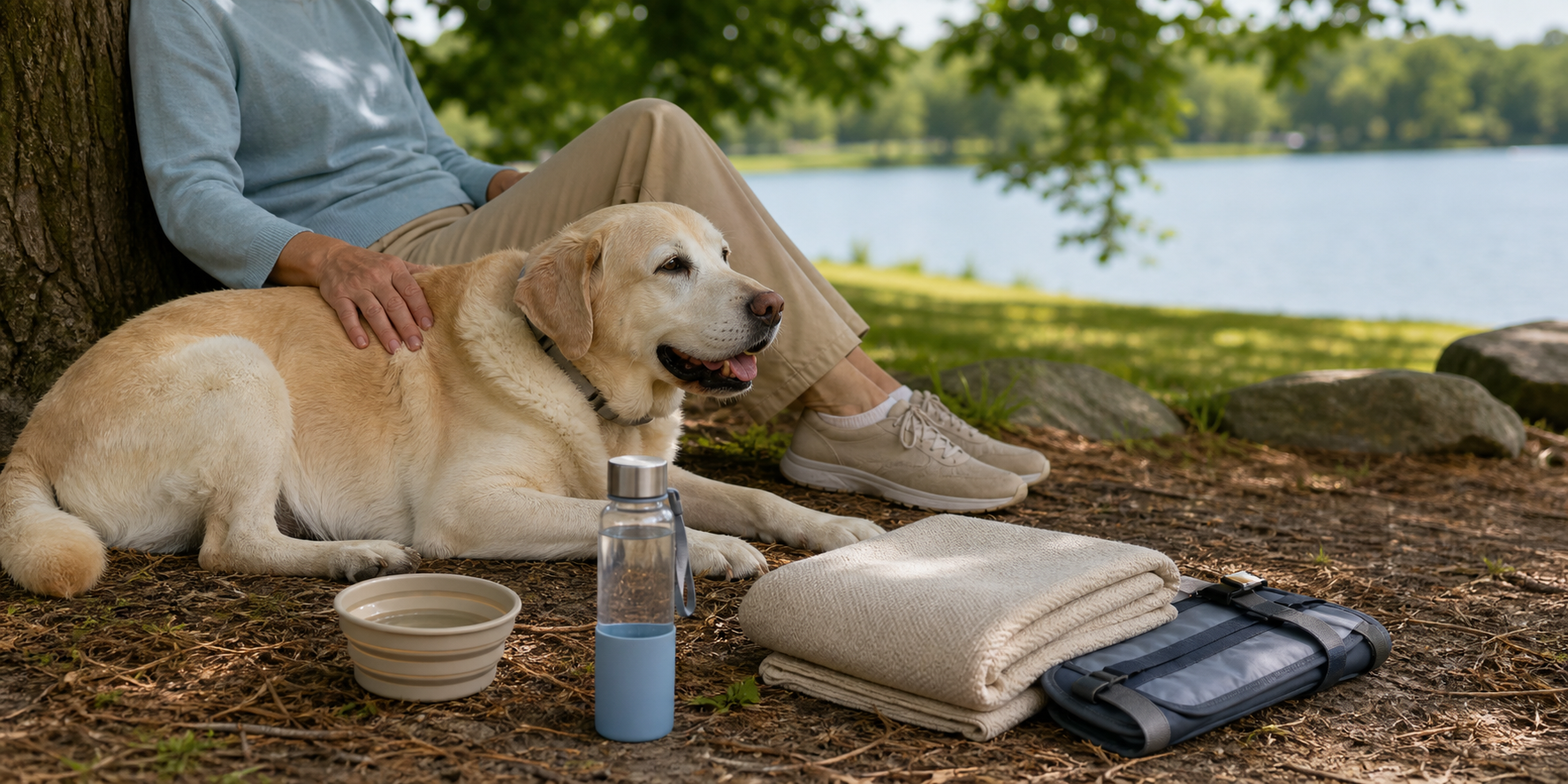
A day trip can give a senior dog new smells and a welcome change of scenery, but car rides, unfamiliar surfaces, temperature changes, and extra walking can add up. The goal is a flexible day that allows your dog to explore, drink, rest, and return home without being pushed beyond current abilities.
Use this senior dog day trip checklist as a planning guide, then adapt it to your dog's health, medications, mobility, and normal routine.
## First Decide Whether the Trip Fits Your Dog Today
Age alone does not determine whether a dog can enjoy a day out. Consider their recent comfort, appetite, movement, and behavior.
Postpone the trip and contact your veterinarian for a new or worsening limp, repeated coughing, breathing changes, vomiting or diarrhea, unusual weakness, confusion, uncontrolled pain, or difficulty entering the car. Dogs recovering from surgery or managing chronic disease may need an individualized travel plan.
If car travel is unfamiliar or stressful, begin with several short practice rides rather than making the day trip the first test. [AAHA advises](https://www.aaha.org/resources/senior-dog-life-stage/) discussing an older dog's mobility, activity, travel stress, and safest method of transport with the veterinary team.
Ask whether your dog will enjoy the destination or be more comfortable at home. A quiet park may suit an older dog better than a crowded festival, steep trail, or full day of errands.
## The Senior Dog Day-Trip Packing Checklist
Pack the night before.
### Identification and health information
- Secure collar or harness with a readable ID tag
- Current microchip registration and phone number
- Photo of your dog and copy of relevant vaccination records
- Your veterinarian's number
- Address and phone number of an emergency veterinary hospital near the destination
- Written list of diagnoses, medications, doses, and allergies
### Water, food, and cleanup
- More fresh water than you expect to use
- Portable bowl
- Regular food or veterinarian-approved snacks if needed
- Any food required with medication
- Waste bags, paper towels, and pet-safe wipes
- Sealable bag for wet or soiled items
### Comfort and mobility
- Familiar fixed-length leash and correctly fitted walking harness
- Nonslip mat or familiar blanket for rest stops
- Ramp or steps if your dog already uses them safely
- Mobility support equipment recommended for your dog
- Towel for wet paws, spills, or extra traction
### Vehicle and emergency supplies
- Properly fitted vehicle restraint or secured travel carrier
- Pet first-aid kit
- Extra medication in original labeled containers
- Charging cable or battery pack for your phone
- Weather-appropriate coat, paw protection, or shade solution when needed
The [AVMA travel guide](https://ebusiness.avma.org/files/productdownloads/traveling_brochure.pdf) also recommends water, health records, medications, identification, and basic first-aid supplies.
## Build a Water Plan, Not Just a Bowl Plan
A portable bowl makes water easier to offer, but it is not the water supply. Bring a separate container filled with enough familiar fresh water for the trip, the drive home, delays, and a small reserve.
The [350 ml collapsible pet travel bowl](https://tendrapaw.com/products/collapsible-pet-travel-bowl-350ml) holds about 11.8 fluid ounces. It is useful for serving water during a stop, but it does not hold a full day's supply. Refill it from the larger container and discard dirty leftover water.
There is no universal amount or schedule that fits every dog. Size, diet, medications, health conditions, activity, temperature, and humidity all affect water needs. Offer fresh water regularly and let your veterinarian guide you if your dog has a condition that changes fluid intake or urination. Do not restrict prescribed access to water simply to reduce bathroom stops.
[Cornell's heat-safety guidance](https://www.vet.cornell.edu/departments-centers-and-institutes/riney-canine-health-center/canine-health-topics/summer-heat-safety-tips-dogs) recommends bringing water and a collapsible bowl and providing frequent opportunities to drink. It also identifies elderly dogs as being at greater risk for heatstroke.
Do not rely on ponds, puddles, communal bowls, or unfamiliar natural water sources. They may contain pathogens, toxins, salt, or blue-green algae. Pack fresh water even when the destination advertises pet fountains.
## Secure the Dog Before the Car Moves
An unrestrained dog can distract the driver and can be injured or injure a passenger during a sudden stop. The [AVMA warns that an unrestrained pet puts both pet and driver at risk](https://ebusiness.avma.org/files/productdownloads/AVMA_PetInCar_Restraint_Flyer_090718.pdf).
Use a vehicle restraint system or carrier made for car travel, sized for your dog, installed exactly as the manufacturer directs, and compatible with your vehicle. The [Center for Pet Safety maintains a current list of independently tested, CPS-certified harnesses, carriers, and crates](https://centerforpetsafety.org/cps-certified/). Certification does not remove the need for correct fit and installation.
Do not connect a car tether to a neck collar. Do not assume an everyday walking harness, lift sling, or untested carrier provides crash protection. Keep your dog away from the driver's lap, pedals, open truck beds, and an open window where the head can extend outside.
Before departure, adjust the temperature and secure loose luggage. Never leave a dog unattended in a parked vehicle—not even with cracked windows or on a mild day. Cornell notes that a car's interior can heat rapidly.
## Plan Every Transition: Home, Car, and Destination
For many senior dogs, getting into and out of the vehicle is harder than the walk itself. Avoid asking your dog to jump from a high cargo floor.
Use a familiar ramp, steps, or lifting method. Add a secure nonslip landing surface and allow extra time; a busy parking lot is not the place to introduce an unstable ramp.
A [rear lift support harness](https://tendrapaw.com/products/rear-lift-support-harness-for-dogs) may help some dogs during short, supervised transitions when it is correctly fitted and appropriate for the dog's condition. It is a mobility aid—not a vehicle restraint, orthopedic treatment, or substitute for veterinary advice. Stop if it causes pressure, rubbing, panic, or discomfort.
For additional walking and access options, browse [senior dog mobility aids](https://tendrapaw.com/collections/senior-mobility), but choose equipment around a veterinarian-guided activity plan rather than using it to extend an outing after your dog is tired.
## Make Rest Part of the Itinerary
Do not wait for obvious exhaustion before taking a break. Schedule more rest than you think your dog will need, especially after the drive, toileting, or walking on unfamiliar ground.
[AAHA recommends](https://www.aaha.org/resources/aging-with-grace-how-to-support-your-senior-pet/) short, consistent, low-impact activity that matches a senior pet's physical condition, mobility, and health. A day trip should follow the same principle: several short sniff-and-rest sessions are usually kinder than one long walk.
Choose a quiet, shaded, level area. Use a familiar mat if the surface is uncomfortable or slippery. Keep the leash attached and let your dog rest without pressure to continue. If the environment is too busy, a climate-controlled vehicle with a person present may offer a calmer break.
Watch recovery, not the clock. Your dog should return toward their usual breathing, posture, and interest before another activity. If they still appear tired after resting, shorten the day.
## Check the Destination Before Exploring
Pause at arrival and scan the area from your dog's height and perspective.
Look for:
- Hot pavement, ice, gravel, holes, steep grades, or slippery flooring
- Stairs, high curbs, narrow docks, and unprotected water edges
- Broken glass, fishing hooks, discarded food, or trash
- Foxtails, thorns, toxic plants, mushrooms, pesticides, and rodent bait
- Off-leash dogs, wildlife, crowds, bicycles, and loud equipment
- Reliable shade, toilets, water refill points, and an easy route back to the car
AAHA's [lifestyle and safety assessment](https://www.aaha.org/resources/life-stage-canine-2019/lifestyle-and-safety-assessment/) highlights temperature extremes, vehicle transport, sharp objects, bodies of water, wildlife, toxins, and reduced senior mobility, vision, hearing, and cognition as hazards to consider.
Keep medications, human snacks, gum, and personal-care products inside closed bags. Save the nearest emergency veterinary hospital and the [ASPCA Animal Poison Control Center](https://www.aspca.org/pet-care/aspca-poison-control) at 888-426-4435; a fee may apply.
## Know When to End the Trip
The plan should always include permission to leave early. End the activity and move to a safe, comfortable place if your dog:
- Falls behind, stops repeatedly, or tries to return to the car
- Develops a limp, shortened stride, trembling, toe dragging, or difficulty rising
- Pants much harder than expected or cannot settle during a break
- Seeks shade urgently, drools excessively, vomits, or appears weak
- Seems confused, frightened, unusually irritable, or unable to navigate familiar cues
- Refuses water when that is unusual, or shows a sudden major change in thirst or urination
Heavy panting, difficulty breathing, weakness, confusion, collapse, or seizures can indicate a heat emergency. Move the dog to a cooler environment and seek veterinary care immediately. Do not continue the outing to “see if it passes.”
## A Simple Low-Pressure Day-Trip Rhythm
A senior-friendly outing might look like this:
1. Normal meal, medication, and bathroom routine at home.
2. Calm loading using familiar mobility equipment.
3. Secured car ride with a planned stop if needed.
4. Water and toileting opportunity after arrival.
5. Short, low-impact exploration at the dog's pace.
6. Quiet shaded rest before the dog appears tired.
7. A second brief activity only if the dog has recovered comfortably.
8. Water, paw check, toileting, and supported loading for the return trip.
9. A quiet evening at home with observation for delayed stiffness or fatigue.
If your dog is unusually sore, restless, weak, or reluctant to move after returning home, contact your veterinarian. Use what you observed to make the next outing shorter, cooler, flatter, or closer to home.
## The Bottom Line
A good day trip with a senior dog is measured by comfort, not distance. Bring a separate supply of fresh water, secure your dog correctly in the vehicle, plan every transition, choose low-impact activity, and schedule rest before fatigue becomes obvious.
Most importantly, keep the itinerary optional. Turning around early is not a failed trip; it is responsive senior-dog care.
*This article provides general educational information and is not a substitute for veterinary diagnosis, treatment, or individualized travel advice.*
---
# Internal Links Used
- `350 ml collapsible pet travel bowl` → `https://tendrapaw.com/products/collapsible-pet-travel-bowl-350ml`
- `rear lift support harness` → `https://tendrapaw.com/products/rear-lift-support-harness-for-dogs`
- `senior dog mobility aids` → `https://tendrapaw.com/collections/senior-mobility`
# Reference Sources
- [American Veterinary Medical Association — Traveling With Your Pet](https://ebusiness.avma.org/files/productdownloads/traveling_brochure.pdf)
- [American Veterinary Medical Association — Pets in Cars: Please Show Some Restraint](https://ebusiness.avma.org/files/productdownloads/AVMA_PetInCar_Restraint_Flyer_090718.pdf)
- [American Animal Hospital Association — Aging With Grace: How to Support Your Senior Pet](https://www.aaha.org/resources/aging-with-grace-how-to-support-your-senior-pet/)
- [American Animal Hospital Association — Senior Dog Life Stage](https://www.aaha.org/resources/senior-dog-life-stage/)
- [American Animal Hospital Association — Lifestyle and Safety Assessment](https://www.aaha.org/resources/life-stage-canine-2019/lifestyle-and-safety-assessment/)
- [Cornell University College of Veterinary Medicine — Summer Heat Safety Tips for Dogs](https://www.vet.cornell.edu/departments-centers-and-institutes/riney-canine-health-center/canine-health-topics/summer-heat-safety-tips-dogs)
- [Center for Pet Safety — CPS Certified Products](https://centerforpetsafety.org/cps-certified/)
- [ASPCA — Traveling With Your Pets: Dos and Don'ts](https://www.aspca.org/news/traveling-your-pets-dos-and-donts)
- [ASPCA — Animal Poison Control Center](https://www.aspca.org/pet-care/aspca-poison-control)