
The Worst Response to a Senior-Dog Accident? Punishment.
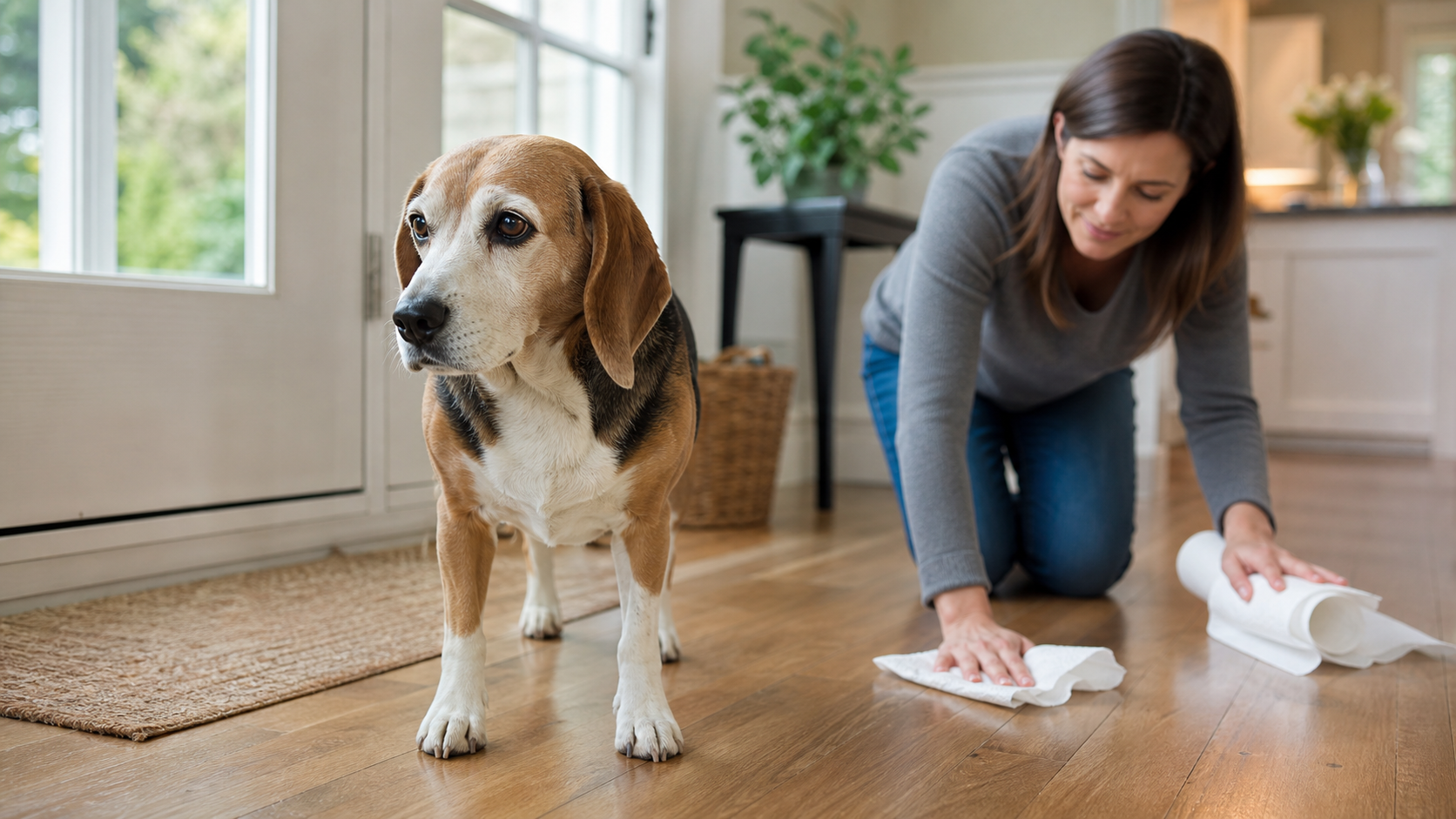
The dog who has not had an accident in years suddenly pees near the door.
Your first feeling may be frustration. Your second may be disbelief: "He knows better."
But a reliably house-trained senior dog who starts having accidents is not automatically being defiant, lazy, or spiteful. The behavior is information. Punishment can add fear while doing nothing to explain why the routine changed.
The [American Animal Hospital Association](https://www.aaha.org/resources/behavior-management-for-pets/) specifically notes that a previously house-trained pet suddenly urinating indoors can have an underlying medical reason. In senior pets, house soiling can also appear alongside pain, mobility difficulty, sensory changes, anxiety, altered sleep, urinary problems, medications, or cognitive changes.
The right first question is not, "How do I stop this?"
It is, **"What changed, and when did it start?"**
## Why Punishment Makes the Story Harder to Read
Scolding after an accident does not teach a senior dog why the body or routine changed. It may teach the dog to hide when they need to eliminate, become anxious around you, or avoid going in front of you.
That can make the pattern harder to observe.
AAHA's behavior guidance supports positive behavior-modification methods and advises against aversive techniques. Fear, pain, and medical conditions can all influence behavior, so a sudden change deserves assessment rather than blame.
Clean the area calmly. Do not rub a dog's nose in the mess. Do not punish a dog for something you discover after the fact. Then start collecting the details that can help the veterinary team.
## The Four Questions That Matter More Than Blame
### 1. Is the dog producing more urine, or getting outside less easily?
Watch for increased water intake, larger urine volume, more frequent attempts, straining, urgency, or blood. A dog may also need more time to reach the door because of stiffness, weakness, poor footing, or reduced vision.
### 2. Did the accident happen during sleep or while awake?
Note the exact location and time. Overnight accidents, accidents near the exit, and accidents after a long nap can tell different stories. Do not interpret the pattern yourself; simply record it.
### 3. Has anything else changed?
Include appetite, thirst, bowel habits, sleep, medication changes, mobility, weight, confusion, new fears, coughing, vomiting, and behavior around family members or other pets.
### 4. Is this truly new?
One accident after an unusually long delay between walks is not the same as a new weekly pattern. Dates and frequency help the veterinarian see the difference.
## House Soiling Is a Symptom, Not a Diagnosis
The [AAHA senior-care guidance](https://www.aaha.org/resources/2023-aaha-senior-care-guidelines-for-dogs-and-cats/evaluating-the-unhealthy-senior-pet/) lists altered thirst, behavior changes, and weight changes among signs that may occur with chronic disease. AAHA's pain-management guidance also warns that accidents and behavior changes can have an underlying medical cause.
Cornell's guide to [senior dog dementia](https://www.vet.cornell.edu/departments-centers-and-institutes/riney-canine-health-center/canine-health-information/senior-dog-dementia) explains that house soiling can occur with cognitive change, but advises veterinary evaluation to rule out issues such as bladder infection first.
The same behavior can have different causes. That is exactly why internet guesses and discipline are poor substitutes for an examination.
## Make a Seven-Day Accident Log
For the next week, record:
- Meals and water-bowl refills
- Walk or outdoor-break times
- Urination and stool timing when known
- Accidents, including time and location
- Straining, urgency, blood, odor, or discomfort
- Sleep schedule
- Medication or diet changes
- Movement changes getting to the door
Bring the log and any relevant videos to the appointment. A simple note such as, "Two overnight accidents, three urgent door requests, drinking more, no change in food" is much more useful than trying to reconstruct everything in the exam room.
## Make the Routine Easier While You Wait for Guidance
Until you speak with a veterinarian, aim for calm predictability:
- Offer more regular outdoor opportunities if your dog can use them safely.
- Keep the route to the exit clear and familiar.
- Avoid suddenly rearranging furniture.
- Use a quiet, neutral response to accidents.
- Protect your dog's dignity; do not isolate or shame them.
Do not start medications, restrict water, or assume the problem is behavioral without veterinary advice.
## When to Call Quickly
Call a veterinarian promptly for new or recurring accidents, increased thirst, frequent urination, straining, blood in urine, reduced appetite, weight loss, weakness, confusion, or pain.
Seek urgent care if your dog cannot urinate, repeatedly strains without producing urine, collapses, has trouble breathing, becomes severely weak, or appears acutely ill.
## The Takeaway
Your senior dog did not erase years of house-training knowledge overnight.
An accident is not a character flaw. It is a change in routine worth understanding. Replace punishment with a log, a calm cleanup, and a veterinary conversation. That response protects both your dog's wellbeing and the information needed to help them.
---
## Sources
1. American Animal Hospital Association. [Behavior Management for Pets](https://www.aaha.org/resources/behavior-management-for-pets/).
2. American Animal Hospital Association. [Age and Behavior](https://www.aaha.org/resources/2015-aaha-canine-and-feline-behavior-management-guidelines/age-and-behavior/).
3. American Animal Hospital Association. [Pain Management for Pets](https://www.aaha.org/resources/pain-management-for-pets/).
4. American Animal Hospital Association. [Evaluating the Unhealthy Senior Pet](https://www.aaha.org/resources/2023-aaha-senior-care-guidelines-for-dogs-and-cats/evaluating-the-unhealthy-senior-pet/).
5. Cornell University College of Veterinary Medicine. [Senior Dog Dementia](https://www.vet.cornell.edu/departments-centers-and-institutes/riney-canine-health-center/canine-health-information/senior-dog-dementia).
## Medical Disclaimer
This article is for general educational purposes only and is not a diagnosis or treatment plan. New house soiling can have medical, behavioral, mobility, or cognitive causes. Contact a licensed veterinarian for guidance tailored to your dog, and seek urgent care if your dog cannot urinate or has severe or sudden signs.