
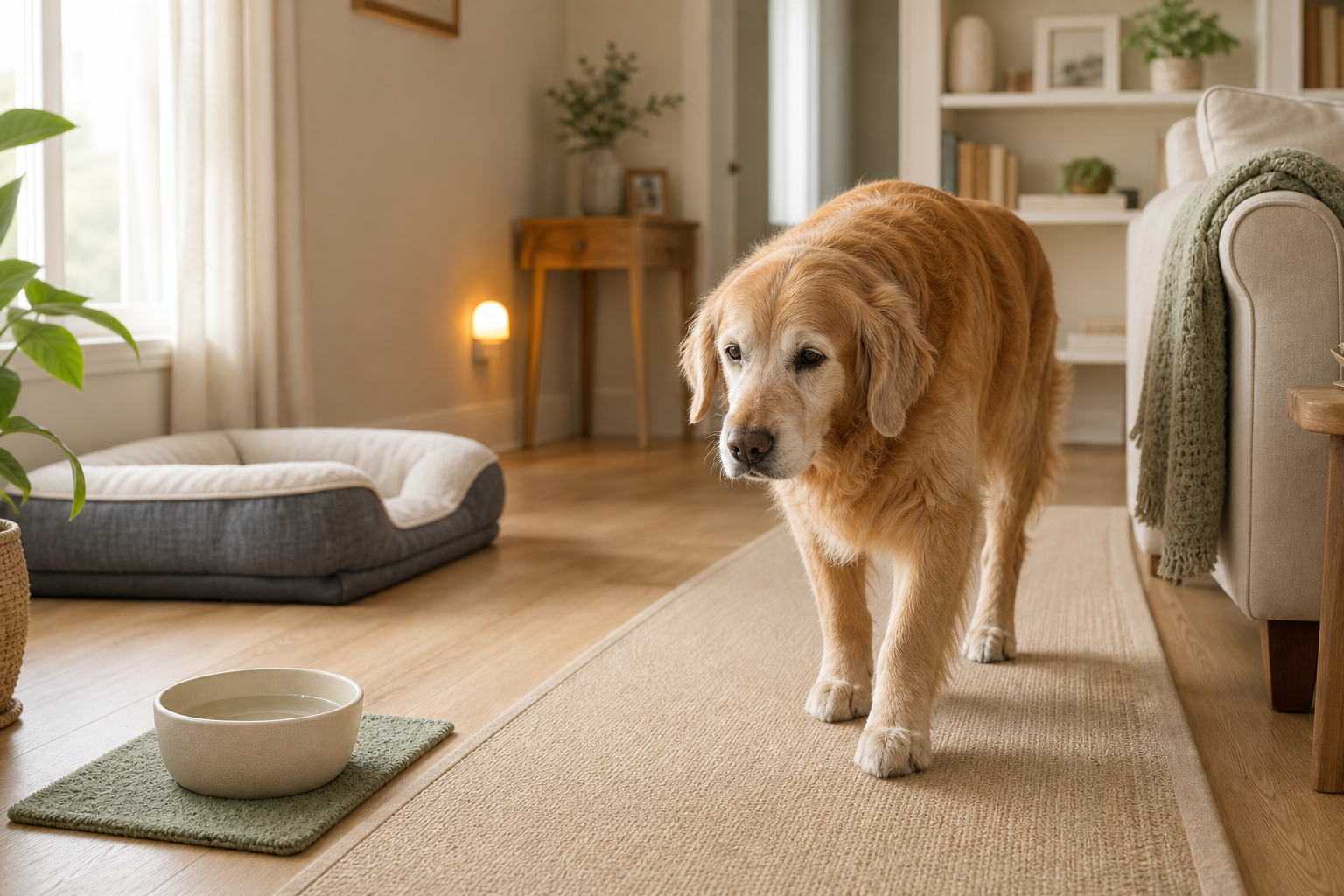
An older dog does not need a house that looks like a hospital. Most need something simpler: fewer slippery moments, easier routes to the places they love, and a routine that does not ask too much of stiff joints, tired legs, fading vision, or a slower mind.
The useful changes are often ordinary. A runner in the hallway. A lamp near the back door. A water bowl that does not slide away. A gate that quietly removes a risky staircase from the day.
Below is a practical way to make your home easier for an aging dog to navigate. Choose the changes that match your dog's habits and your home, rather than trying to do everything at once.
## Start by Watching the Ordinary Moments
Before buying anything, spend a day noticing where your dog pauses or seems uncertain. The most revealing moments are often small:
- Getting up after a nap
- Turning a corner on a smooth floor
- Reaching the water bowl
- Going through a doorway
- Heading outside at night
- Climbing into the car
- Approaching stairs
Video can be useful here. AAHA encourages owners to share pictures and videos of mobility or unusual behavior seen at home because these details can help a veterinary team spot patterns that may not show up during a short clinic visit.[^1]
If changes are sudden, or your dog seems painful, weak, confused, or unable to stand, contact a veterinarian rather than assuming it is a normal part of aging.
## 1. Give Your Dog Reliable Footing
Smooth floors are often the first thing to address. Older dogs with reduced strength, joint disease, or balance changes can lose confidence after slipping. The goal is not to carpet every room. It is to create stable routes between the places your dog uses most.
Place non-slip rugs, runners, or yoga mats in high-traffic areas, such as:
- Between the bed and the door
- Along the hallway
- Near food and water bowls
- Beside the sofa or favorite resting place
- At exterior doors
- At the base and top of any stairs
Make sure every rug is anchored. A loose rug that slides underneath a dog can create a new fall risk.
This recommendation is well supported in senior-care guidance. AAHA lists rugs and yoga mats as ways to provide better footing, and a review of canine osteoarthritis rehabilitation notes that adding carpet or rubber matting in essential areas can improve a dog's confidence and ability to move safely at home.[^2][^3]
## 2. Reduce the Need for Stairs
Stairs are not automatically off limits for every senior dog, but they deserve an honest look. An older dog may manage them one day and struggle the next, especially when tired, sore, or rushed.
Use a sturdy baby gate to limit unsupervised stair access if your dog is unsteady. If stairs are unavoidable, improve the grip, keep the route well lit, and stay close during use. Try to keep food, water, beds, and family time on the same level when practical.
For cars, sofas, and low beds, a stable ramp or step can be useful for the right dog. Let your dog learn it slowly with treats and calm encouragement. Do not pull them up a ramp or force a dog who appears frightened or painful.
## 3. Make Resting Areas Easy to Reach
Older dogs rest more, but getting up can be the hard part. A supportive bed in a quiet, easy-to-reach spot can make a real difference.
Choose a resting area that has:
- A non-slip surface around it
- Enough space to stand and turn
- A clear path to water and the door
- No need to jump onto furniture
- Less foot traffic and fewer surprises
If your dog enjoys being near the family, put a bed in the living room instead of isolating them in a separate room. Comfort is not only about cushioning; familiar company and predictable routines matter too.
## 4. Improve Nighttime Navigation
Many senior dogs wake up to drink, reposition, or go outside. Reduced vision, hearing changes, and cognitive aging can make a dark home more confusing than it used to be.
Add simple nightlights along the route from bed to water and to the door. Keep furniture in consistent locations and avoid leaving boxes, shoes, or laundry in the walking path. Cornell's senior-dog guidance also recommends blocking off unsafe areas such as stairs and using nightlights for dogs that wander at night.[^4]
Aim for a softly lit path rather than a bright, disruptive room. The point is orientation, not keeping your dog awake.
## 5. Set Up Food and Water for Success
Food and water bowls can become surprisingly awkward when a dog is stiff or unsteady. Put them on a non-slip mat and keep spills wiped up. Use bowls that are stable enough not to scoot away while your dog eats or drinks.
For some larger dogs, raised bowls can be useful, but they are not universally appropriate. Ask your veterinarian whether changing bowl height makes sense for your dog's size, condition, and medical history.
Also consider location. A bowl in the middle of a slippery kitchen may be harder to reach than one placed along the dog's safer walking path.
## 6. Clear the Routes You Use Every Day
Senior dogs do best when they do not have to navigate obstacles. This matters particularly for dogs with declining vision, hearing, or cognitive function.
Pick up items that roll, tangle, or block the floor. Secure power cords. Keep furniture layouts stable. Make sure the route to the yard does not require squeezing through a narrow, cluttered area.
AAHA advises giving older dogs traction on floors and stairs, minimizing unnecessary stair climbing, and reducing clutter for cognitively impaired dogs who may wander or bump into furniture.[^5]
## 7. Make Outdoor Breaks More Predictable
Look at the path from the door to the toilet area. Is it muddy, icy, uneven, or poorly lit? A short, even route is kinder on an aging dog than a long trek over unpredictable ground.
Keep outdoor trips calm and unhurried. If your dog needs help rising or walking, ask your veterinarian or a qualified rehabilitation professional whether a properly fitted support harness is suitable. A harness can assist with balance and lifting, but it should not cause rubbing, twisting, or pressure on a sore area.
## 8. Keep a Simple Mobility Diary
You do not need to track every step. Once a week, make a short note about things like getting up, using stairs, appetite, sleep, walks, and slips. A few phone videos from the same angle can also be helpful.
This creates a clearer picture of gradual changes and gives your veterinarian useful information at checkups. AAHA recommends regular monitoring for senior pets, including changes in mobility and behavior.[^1]
## A Small Home Checklist
Walk through your home and ask:
- Does my dog have a stable path from bed to water to the door?
- Are rugs and mats secured so they cannot slide?
- Can my dog avoid unsupervised stairs?
- Is there light for nighttime trips?
- Are beds, bowls, and favorite resting spots easy to access?
- Have I cleared clutter from the routes my dog uses every day?
- Have I shared new mobility changes with my veterinarian?
You may only need to fix one or two things first. For many dogs, a safer hallway and a better resting area are a meaningful start.
## The Bottom Line
Making a home senior-dog friendly is not about treating your dog as fragile. It is about removing unnecessary friction from ordinary life so they can keep doing familiar things with more confidence.
Start with the route your dog uses most, make it safer, and watch how they respond. Small adjustments can add up to calmer days for both of you.
At TendraPaw, we believe everyday comfort is built from practical details: secure footing, accessible rest, and support that fits naturally into a dog's routine.
## FAQ
### What is the easiest way to help an old dog on slippery floors?
Start with secured non-slip rugs or runners in the places your dog walks most. Keep nails trimmed, wipe up spills, and speak with your veterinarian if slipping is new or worsening.
### Should senior dogs still use stairs?
It depends on the individual dog. Dogs who are unsteady, painful, or falling should not use stairs unsupervised. Your veterinarian can help you decide whether stairs, a ramp, or a gate is safest.
### Does my senior dog need a raised food bowl?
Some dogs may find a raised bowl more comfortable, but it is not right for every dog. Ask your veterinarian before changing bowl height, especially if your dog has a medical condition.
### How often should an older dog see the veterinarian?
AAHA advises semiannual veterinary visits for senior pets because health changes can occur more quickly with age. Your veterinarian may recommend a different schedule for your dog.[^6]
## Sources and further reading
[^1]: [AAHA, Creating a Senior-Friendly Hospital](https://www.aaha.org/resources/2023-aaha-senior-care-guidelines-for-dogs-and-cats/creating-a-senior-friendly-hospital/)
[^2]: [AAHA, Pain Management: 2023 Senior Care Guidelines](https://www.aaha.org/resources/2023-aaha-senior-care-guidelines-for-dogs-and-cats/pain-management/)
[^3]: [Physiotherapeutic Strategies and Their Current Evidence for Canine Osteoarthritis](https://pmc.ncbi.nlm.nih.gov/articles/PMC9863568/)
[^4]: [Cornell University College of Veterinary Medicine, Senior Dog Dementia](https://www.vet.cornell.edu/departments-centers-and-institutes/riney-canine-health-center/canine-health-information/senior-dog-dementia)
[^5]: [AAHA, Lifestyle and Safety Assessment](https://www.aaha.org/resources/life-stage-canine-2019/lifestyle-and-safety-assessment/)
[^6]: [AAHA, Aging With Grace: How to Support Your Senior Pet](https://www.aaha.org/resources/aging-with-grace-how-to-support-your-senior-pet/)