
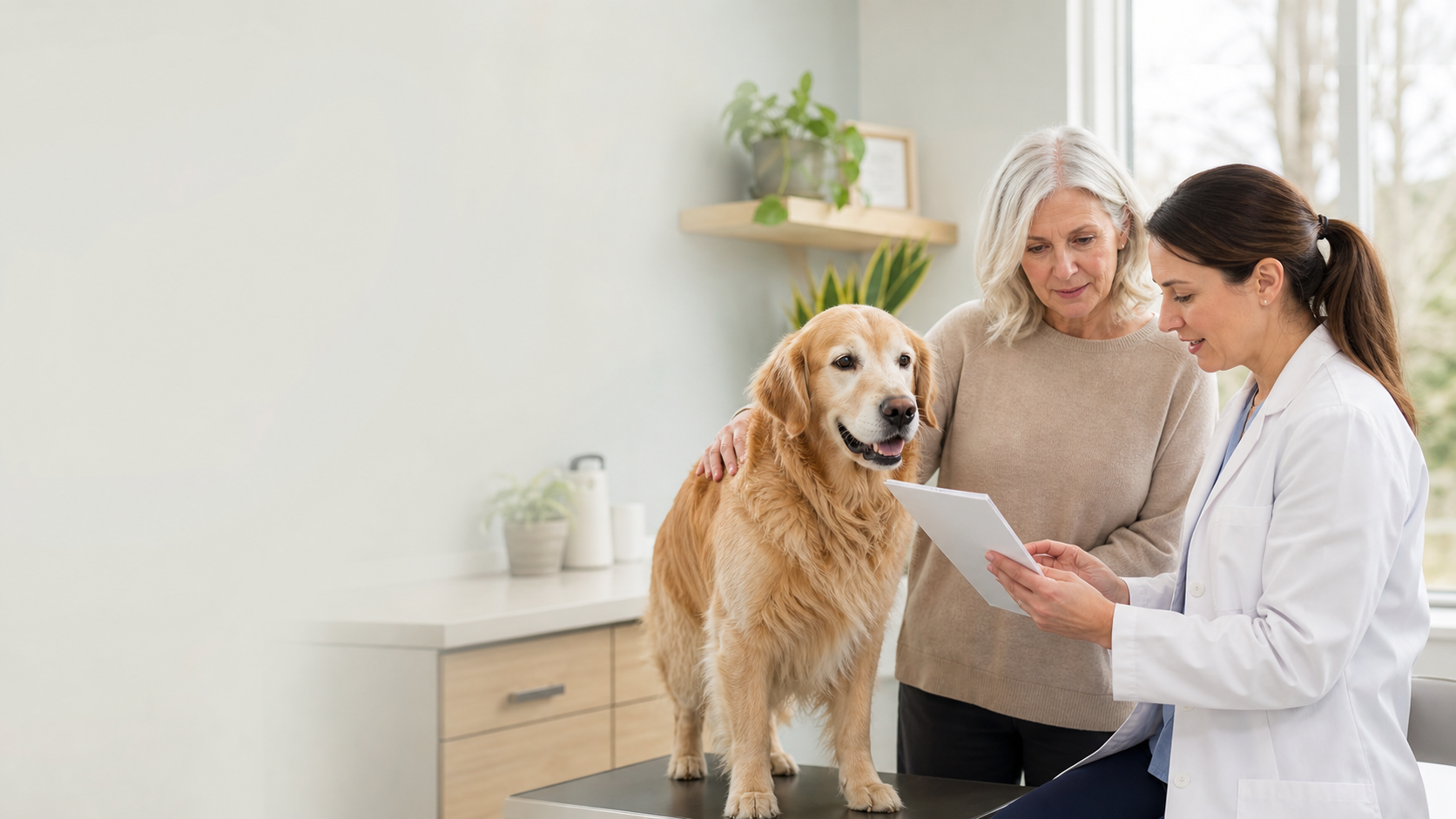
The "He Looks Fine" Trap: Why Senior-Dog Care Starts Before Symptoms
He ate breakfast.
He barked at the delivery truck.
He brought you the same battered toy he has loved for years.
So why schedule a senior checkup when nothing appears to be wrong?
Because **"looks fine" is a moment, not a baseline.**
A photograph can show a bright expression and a wagging tail. It cannot show whether body weight, muscle condition, kidney values, dental health, blood pressure, mobility, or daily behavior has changed since last year. And once a change becomes obvious at home, the most useful comparison is often the information collected when your dog still seemed completely normal.
This is not a reason to panic or search for hidden disease. It is a reason to stop treating preventive care as something that begins only after symptoms appear.
## First, Forget the Universal Senior Birthday
Not every dog becomes senior at age seven.
The [American Animal Hospital Association's Canine Life Stage Definitions](https://www.aaha.org/resources/life-stage-canine-2019/canine-life-stage-definitions/) define the senior stage as the final 25% of a dog's estimated lifespan. Breed, body size, genetics, health history, and individual condition all affect that estimate.
That means a large or giant dog may enter the senior stage years before a small dog of the same chronological age. Your veterinarian can help estimate your dog's life stage and decide when a senior-focused plan makes sense.
The calendar opens the conversation. It does not make the medical decisions.
## What a Health Baseline Actually Means
A baseline is a recorded picture of your dog's health at a particular point in time.
It may include physical examination findings, body weight, body and muscle condition, oral health, behavior and mobility observations, medication history, and laboratory results selected by the veterinarian. The value is not that one result can predict the future. The value is that future results have something meaningful to be compared with.
Imagine two dogs with the same laboratory value today. For one dog, it is almost identical to the previous three results. For the other, it has moved steadily over several visits. The number alone may not tell the full story; the trend adds context.
The [2023 AAHA Senior Care Guidelines](https://www.aaha.org/resources/2023-aaha-senior-care-guidelines-for-dogs-and-cats/) describe senior care as individualized and recommend a thorough history, physical assessment, and appropriate screening. They also emphasize that apparently healthy senior pets and unhealthy senior pets require different approaches.
In other words, a baseline is not a diagnosis. It is a reference point.
## Why "Still Eating" Is Not a Complete Screening Test
Owners naturally use visible habits as proof of health:
- "He still eats."
- "She still wants to walk."
- "He still greets me."
- "She still wags her tail."
Those observations matter, and veterinarians want to hear them. But dogs can continue familiar routines while adapting to discomfort or gradual change. Appetite alone does not assess the mouth, heart, lungs, abdomen, joints, nervous system, skin, muscle, or internal organ function.
The [American Veterinary Medical Association's senior pet guide](https://ebusiness.avma.org/files/ProductDownloads/mcm-client-brochures-senior-pets-2023.pdf) notes that regular veterinary examinations and testing can help detect problems that may not be obvious to the family.
That does not mean every senior dog has an illness. It means appearance alone cannot answer every health question.
## What a Senior Wellness Visit May Establish
The exact visit should be tailored to the dog. A healthy Chihuahua, a Labrador with a long medication list, and a mixed-breed dog with an unknown history do not need identical plans.
Depending on the individual, a senior visit may address the following.
### 1. A detailed history
The veterinary team may ask about:
- Food, treats, supplements, and medications
- Appetite and water intake
- Urination and bowel habits
- Sleep and behavior
- Exercise tolerance
- Coughing or breathing changes
- Mobility at home
- Vision and hearing
- New lumps or skin changes
- Comfort during handling
Do not worry if an answer seems too ordinary. The pattern is often more useful than a dramatic story.
### 2. Weight, body condition, and muscle condition
The number on the scale is only one piece of the assessment. A dog can maintain the same weight while losing muscle and gaining fat.
AAHA's [Canine Life Stage Checklist](https://www.aaha.org/resources/life-stage-canine-2019/life-stage-checklist/) includes nutritional assessment, body condition, muscle condition, pain, and physical examination among the items veterinary teams should review.
Ask the team to explain your dog's body condition score and muscle condition score. Knowing what those terms mean makes future changes easier to recognize.
### 3. A complete physical and oral examination
A nose-to-tail examination may assess the eyes, ears, mouth, heart, lungs, abdomen, skin, lymph nodes, joints, gait, and other body systems. Findings determine whether anything needs closer evaluation.
Dental disease becomes more common with age, but bad breath, difficulty chewing, dropping food, or favoring one side of the mouth should not be accepted automatically as "old dog things." A brief awake oral check also cannot show every structure below the gumline, so ask what the veterinarian can and cannot conclude from the exam.
### 4. Mobility, pain, behavior, and cognition
Dogs may move differently in a clinic because they are excited, anxious, or walking on unfamiliar flooring. Short home videos can add valuable context.
The senior care guidelines recommend using videos and owner observations to help assess pain, movement, and behavior. A veterinarian may ask how the dog rises, turns, uses stairs, sleeps, interacts, or navigates familiar spaces.
This is screening, not a label. Pain, sensory loss, medication effects, anxiety, medical disease, and cognitive change can create overlapping signs.
### 5. Diagnostic tests chosen for the individual
AAHA provides a table of [diagnostic tests and recommended frequencies for senior dogs](https://www.aaha.org/resources/2023-aaha-senior-care-guidelines-for-dogs-and-cats/diagnostic-tests-and-recommended-frequencies-for-senior-dogs-and-cats/). It lists tests a veterinary team may consider, including blood count, chemistry, urinalysis, and other screening based on risk.
It is not a universal shopping list.
Previous results, breed risk, medications, current signs, examination findings, and the dog's overall health should guide what is appropriate. Ask the veterinarian what each recommended test is intended to evaluate and how the result would affect the plan.
## How Often Should a Healthy Senior Dog Be Examined?
AAHA's public [senior veterinary care recommendations](https://www.aaha.org/resources/supporting-your-senior-pet-veterinary-care-recommendations/) advise examinations every six months for senior pets, including those who appear healthy. Dogs with chronic conditions, new symptoms, medication-monitoring needs, or higher risks may need a different schedule.
Six months is not a guarantee that a problem will be found early, and it is not a reason to wait when something changes. It is a general preventive-care interval to discuss with your veterinarian.
Put the next planned visit on the calendar before leaving the clinic. "We will remember next year" is how a baseline quietly becomes two years old.
## The 48-Hour Checkup Prep That Makes the Visit Better
You do not need a binder full of records. A clear one-page summary is usually more helpful.
Before the appointment, collect:
1. **A complete list of medications and supplements.** Include the product name, amount given, and frequency. Photographs of labels can help.
2. **The exact food and treat list.** Include brand, formula, approximate daily amount, toppers, chews, and table food.
3. **Recent records from other clinics.** Do not assume every location automatically shares results.
4. **Three short home videos.** Consider normal rising, walking, turning, or another routine movement. Never stage a risky task.
5. **A concise change log.** Note dates and frequency rather than writing "sometimes."
6. **Your three most important questions.** Put them at the top so they are not lost during the visit.
Do not fast your dog, stop medication, or change the routine before testing unless the veterinary team gives specific instructions.
## Ask for the Baseline, Not Just "Everything Is Normal"
At the end of the visit, ask:
- What are my dog's body and muscle condition scores?
- Which findings are now part of the baseline?
- Are any results worth rechecking or trending?
- What change should prompt a call before the next visit?
- When is the next examination or test due?
- Should I monitor anything specific at home?
- Can I have a copy of the examination summary and laboratory results?
"Normal" is reassuring, but a copy of the actual findings is more useful for comparison later.
One normal visit also does not guarantee that nothing can change before the next one. Preventive care lowers uncertainty; it does not eliminate it.
## Do Not Wait for the Baseline Visit When Something Is Wrong
A scheduled wellness appointment is not an emergency plan.
Contact a veterinarian sooner for a new, recurring, or worsening change in appetite, thirst, urination, bowel habits, weight, breathing, mobility, sleep, behavior, or comfort.
Seek urgent veterinary care for collapse, trouble breathing, inability to stand, seizures, major trauma, uncontrolled bleeding, repeated unproductive retching, a swollen painful abdomen, pale or blue gums, suspected toxin exposure, or severe and rapidly worsening distress.
This list is not exhaustive. If you are unsure, call a veterinary clinic or emergency hospital and describe the signs.
## "Looks Fine" Should Start the Record, Not End the Conversation
A healthy senior checkup is not wasted because the veterinarian finds nothing alarming.
That visit can document what normal looks like for your dog today. It can establish trends, identify questions, update the care schedule, and give you clearer instructions for what to watch between visits.
The best baseline is collected before memory has to reconstruct it.
Your senior dog may truly be doing well. That is not a reason to postpone the conversation.
It is the ideal time to begin it.
---
## Sources
1. American Animal Hospital Association. [2023 AAHA Senior Care Guidelines for Dogs and Cats](https://www.aaha.org/resources/2023-aaha-senior-care-guidelines-for-dogs-and-cats/).
2. American Animal Hospital Association. [Canine Life Stage Definitions](https://www.aaha.org/resources/life-stage-canine-2019/canine-life-stage-definitions/).
3. American Animal Hospital Association. [Supporting Your Senior Pet: Veterinary Care Recommendations](https://www.aaha.org/resources/supporting-your-senior-pet-veterinary-care-recommendations/).
4. American Animal Hospital Association. [Diagnostic Tests and Recommended Frequencies for Senior Dogs and Cats](https://www.aaha.org/resources/2023-aaha-senior-care-guidelines-for-dogs-and-cats/diagnostic-tests-and-recommended-frequencies-for-senior-dogs-and-cats/).
5. American Animal Hospital Association. [Canine Life Stage Checklist](https://www.aaha.org/resources/life-stage-canine-2019/life-stage-checklist/).
6. American Veterinary Medical Association. [Senior Pets: What You Should Know](https://ebusiness.avma.org/files/ProductDownloads/mcm-client-brochures-senior-pets-2023.pdf).
## Medical Disclaimer
This article is for general educational purposes only and is not a substitute for veterinary examination, diagnosis, or treatment. Screening plans, testing intervals, and senior status vary by breed, size, health history, medication use, and individual condition. Contact your veterinarian for advice tailored to your dog, and seek urgent veterinary care for sudden or severe signs.