
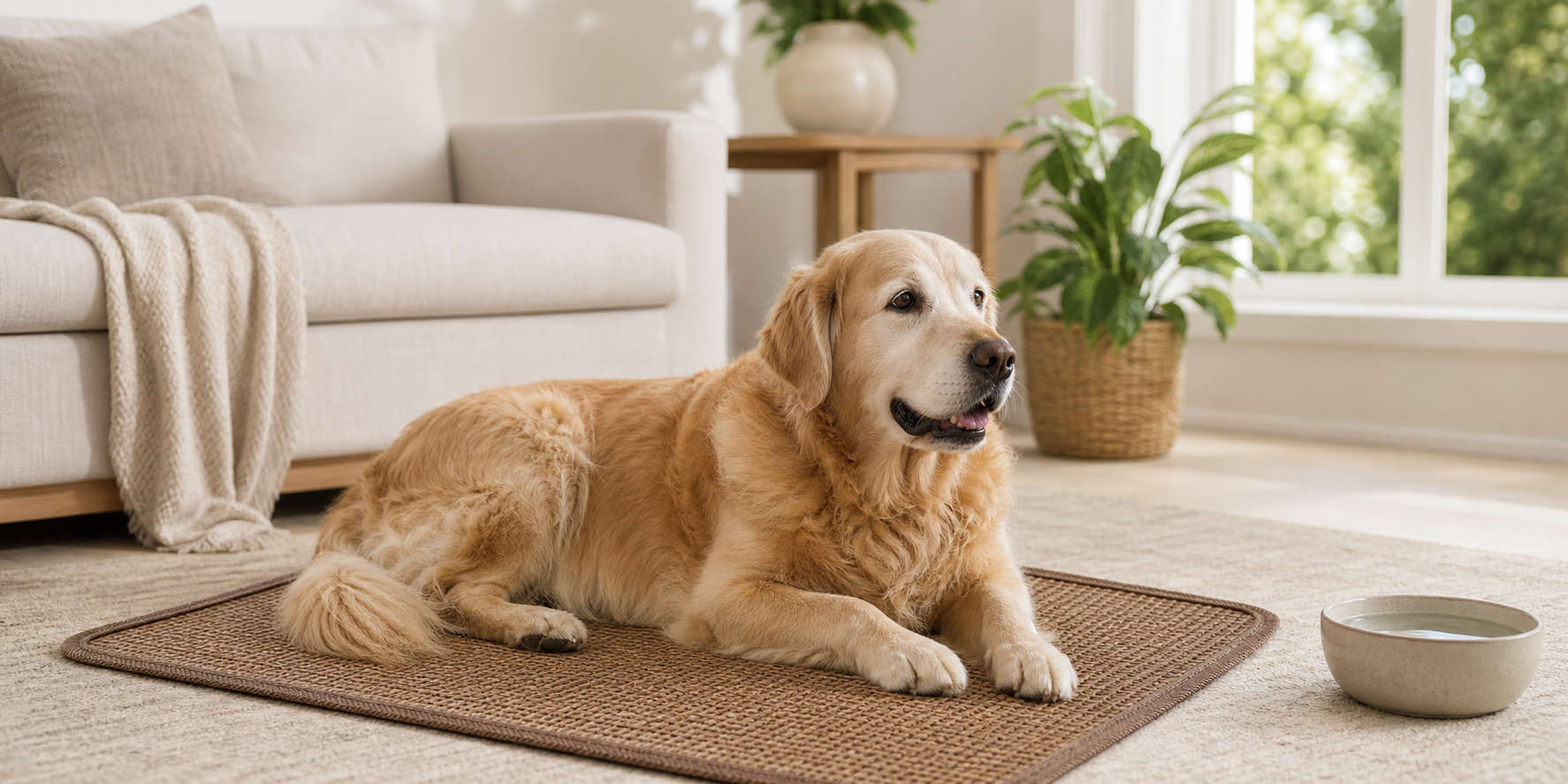
When the weather gets warmer, many dogs start seeking out tile floors, shady corners, or spaces near an air-conditioning vent. Senior dogs may need even more help finding a resting place that feels comfortable without being difficult to access.
Two popular options are an elevated mesh dog bed and a low-profile cooling mat. Although both can provide a less heat-trapping alternative to thick plush bedding, they work in different ways. Neither option is automatically better for every dog.
The right choice depends on your dog’s mobility, preferred sleeping position, home temperature, body size, and ability to step onto or off the surface safely.
## Quick Answer
Choose an **elevated mesh dog bed** if your dog:
- Prefers a firm, raised sleeping surface
- Benefits from airflow above and below the body
- Can step onto and off a low frame confidently
- Needs separation from a warm, cold, dusty, or damp floor
- Enjoys indoor or covered outdoor resting areas
Choose a **breathable woven cooling mat** if your dog:
- Needs a nearly floor-level resting surface
- Has difficulty stepping over raised edges
- Likes a firm, thin mat rather than a padded bed
- Needs a portable option for floors, crates, carriers, or existing beds
- Would benefit from a cooler-feeling surface without gel or refrigeration
Some dogs may enjoy both: a raised bed in a favorite daytime location and a low-profile mat near their nighttime sleeping area.
## Elevated Dog Bed vs. Cooling Mat at a Glance
| Feature | Elevated Mesh Bed | Breathable Woven Mat |
|---|---|---|
| Height | Raised above the floor | Low profile |
| Airflow | Above and beneath the sleeping surface | Across the woven surface |
| Accessibility | Requires stepping onto the frame | Easier for many mobility-limited dogs |
| Cushioning | Firm, tensioned mesh | Thin and firm |
| Portability | Less portable because of the frame | Lightweight and easy to move |
| Cleaning | Mesh can usually be wiped or rinsed | Best wiped clean and air-dried |
| Best location | Indoor or dry, covered outdoor area | Floor, crate, carrier, sofa, or pet bed |
| Cooling method | Passive airflow | Breathable, less heat-trapping surface |
| Electricity or refrigeration | Not required | Not required |
## Benefits of an Elevated Mesh Dog Bed
An elevated bed holds the sleeping surface above the floor. This open space allows air to move beneath the bed, which can make it a useful warm-weather resting option in a well-ventilated room or shaded, covered area.
It also separates your dog from surfaces that may feel uncomfortably warm, cold, dusty, or damp. A tightly woven mesh surface is generally easier to wipe down than thick fabric bedding and does not contain heat-trapping stuffing.
TendraPaw’s [Elevated Breathable Mesh Dog Bed](https://tendrapaw.com/products/elevated-breathable-mesh-dog-bed) uses a reinforced steel frame and is available in multiple sizes for different resting spaces.
However, a raised bed still requires your dog to step up and down. Senior dogs with reduced balance, rear-leg weakness, limited vision, or hesitation around unfamiliar surfaces may find even a low frame challenging. Place the bed on a stable, nonslip floor and watch your dog enter and leave it before allowing unsupervised use.
An elevated mesh bed is also firm rather than deeply cushioned. Dogs that frequently change position, avoid firm surfaces, or have been advised to use orthopedic bedding may prefer a different option or an additional accessible bed elsewhere in the home.
## Benefits of a Breathable Woven Cooling Mat
A woven mat rests directly on the floor or another stable surface, so there is little or no step-up height. That can make it easier to access for dogs that move slowly, shuffle their feet, or hesitate before climbing onto raised furniture.
The rattan-style woven surface provides a less plush, less heat-trapping place to rest. It does not contain cooling gel and does not need water, electricity, freezing, or refrigeration. It can be moved between rooms and may fit inside a crate, carrier, existing pet bed, or favorite floor-level sleeping area when correctly sized.
The [Breathable Woven Pet Cooling Mat](https://tendrapaw.com/products/breathable-woven-pet-cooling-mat) is available in six sizes, allowing owners to choose based on their dog’s full resting length rather than weight alone.
The tradeoff is that a thin woven mat provides less padding than a cushioned bed. It may also slide on polished flooring unless placed on a secure, nonslip surface. Check it regularly for lifted edges, fraying, or damage, especially if your dog scratches or chews bedding.
A passive woven mat may feel cooler than thick plush fabric, but it does not actively lower your dog’s body temperature or the temperature of the room.
## How to Choose for a Senior Dog
### 1. Watch How Your Dog Gets Up and Lies Down
Observe your dog during a normal day. Does your dog lower the body slowly? Hesitate before stepping over an edge? Circle repeatedly before lying down? Struggle to rise after resting?
The American Animal Hospital Association advises owners to monitor senior pets for changes such as difficulty rising, stiffness, altered mobility, and taking a long time to find a comfortable position. These signs deserve a veterinary conversation rather than simply changing the bed. [AAHA also notes](https://www.aaha.org/resources/how-to-assess-your-senior-pets-quality-of-life/) that accessible bedding and nonslip surfaces can be useful environmental modifications.
If stepping up appears difficult, begin with a floor-level mat. If your dog remains confident and actively chooses elevated surfaces, a stable raised bed may still be suitable.
### 2. Consider Stability and Traction
Whichever option you select, it should remain still when your dog steps on it. Avoid placing a lightweight mat directly on a slick floor if it slides or curls. Check that an elevated frame sits level and that every connection is securely assembled.
AAHA recommends improving traction and reducing unnecessary stair use as dogs age. A clear path, nonslip rugs, and an accessible bed on the main living level can matter just as much as the bed itself.
### 3. Measure Sleeping Size, Not Only Body Weight
Measure your dog from nose to the base of the tail while resting naturally, then add enough room for stretching and repositioning. Weight guides can help narrow the options, but they do not tell you how much surface area your dog uses while asleep.
### 4. Match the Surface to Your Dog’s Preference
Some dogs naturally choose firm tile or woven surfaces in summer. Others continue to seek soft padding even in warm weather. Give your dog a choice when possible and note which surface is used consistently.
For a senior dog, the best bed is not the one with the longest feature list. It is the one the dog can reach safely, lie on comfortably, and leave without struggling.
## Can You Use Both?
Yes. Offering two rest stations can be useful when your dog moves between warmer and cooler parts of the home.
For example:
- Place an elevated bed in a ventilated living area.
- Put a woven mat near the dog’s nighttime sleeping space.
- Keep both away from direct sunlight.
- Make sure fresh water is easy to reach.
- Allow your dog to choose rather than requiring use of one surface.
Avoid loosely stacking the mat on top of an elevated mesh bed unless it fits securely and does not bunch, slide, or cover the frame in a way that creates a trip hazard.
## A Bed or Mat Is Not a Heat-Safety Plan
Cooling products are comfort accessories, not protection against heatstroke. [Cornell University’s summer heat guidance](https://www.vet.cornell.edu/departments-centers-and-institutes/riney-canine-health-center/canine-health-topics/summer-heat-safety-tips-dogs) identifies elderly dogs among those at higher risk during hot weather and recommends shade, frequent water breaks, cooler activity times, and indoor air conditioning or fans during extreme heat.
[AAHA’s heatstroke-prevention guidance](https://www.aaha.org/resources/how-to-prevent-heatstroke-in-dogs-and-cats/) recommends ventilation, shade, fresh water, and access to air conditioning during hot weather. It lists cooling mats as one possible comfort tool, not a replacement for environmental temperature control.
Heavy or excessive panting, drooling, difficulty breathing, vomiting, weakness, confusion, stumbling, seizures, or collapse can signal a heat emergency. Move the dog to a cooler area and contact a veterinarian immediately.
## The Bottom Line
An elevated mesh bed is a strong option for airflow, easy cleaning, and separation from the floor, provided your senior dog can step onto it safely. A breathable woven mat offers easier floor-level access and greater portability but provides less padding and only passive cooling comfort.
Start with your dog’s mobility and habits, not the product category. Measure carefully, provide traction, keep the resting area cool and shaded, and let your dog show you which surface feels best.
*This article provides general educational information and is not a substitute for veterinary diagnosis or treatment.*
---
# Internal Links Used
- `Elevated Breathable Mesh Dog Bed` → `https://tendrapaw.com/products/elevated-breathable-mesh-dog-bed`
- `Breathable Woven Pet Cooling Mat` → `https://tendrapaw.com/products/breathable-woven-pet-cooling-mat`
- Optional additional link: `home safety and anti-slip solutions` → `https://tendrapaw.com/collections/anti-slip-home`
# Reference Sources
- [Cornell University College of Veterinary Medicine — Summer Heat Safety Tips for Dogs](https://www.vet.cornell.edu/departments-centers-and-institutes/riney-canine-health-center/canine-health-topics/summer-heat-safety-tips-dogs)
- [AAHA — How to Prevent Heatstroke in Dogs and Cats](https://www.aaha.org/resources/how-to-prevent-heatstroke-in-dogs-and-cats/)
- [AAHA — How to Assess Your Senior Pet’s Quality of Life](https://www.aaha.org/resources/how-to-assess-your-senior-pets-quality-of-life/)
- [AAHA — Senior Pet Home Monitoring Guide](https://www.aaha.org/wp-content/uploads/globalassets/02-guidelines/2023-aaha-senior-care-guidelines-for-dogs-and-cats/resources/aaha-senior-care-guidelines-your-senior-pet.pdf)